Home cooks are always on the lookout for economical ways to make a meal. When it comes to selecting meat, beef has become something I only buy on rare occasions, due to skyrocketing prices. Pork and chicken prices have also increased over the last few years, but good deals can still be found. Chicken thighs and leg quarters tend to be the least expensive cuts. Pork loins and pork rib meat find their way into my shopping basket more and more, because of their affordability.
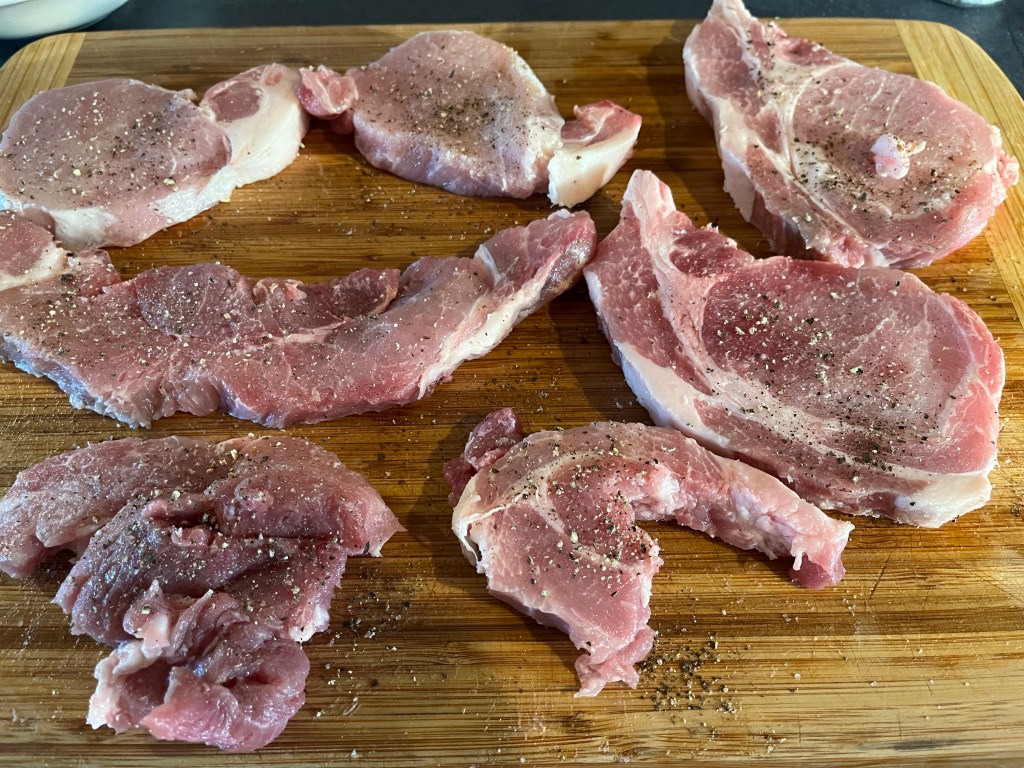
Country-style pork ribs are cut from the area of the hog where the loin meets the shoulder. Country-style ribs are a blend of lean white meat and rich dark meat, which makes them a versatile cut of meat.
Carnitas are typically made from roasted pork shoulder, but they can be made from slow-cooked pork loin, too. Since I chose country-style rib meat for this recipe, I chose to sear the meat in a pan and then gently stew, with broth and vegetables.
Homemade tortillas make this Mexican dinner even more special!
Ingredients:
2 lbs. marinated country-style pork rib meat
¼ cup cooking oil
1 medium sized onion, chopped
1 large jalapeño, seeded and chopped
1 cup picante sauce (salsa)
1 cup chicken stock
Chopped lettuce, tomatoes, and onions (for the tacos)
1 lime, sliced
10 warm flour tortillas
Tapatio hot sauce
Directions:
I’ve got to confess that I forgot what I used in the marinade for the pork. Most likely, I used a combination of tomato sauce, dark soy sauce, lime juice, dried onion flake, cumin powder, red chili powder, paprika, garlic powder, and a pinch of turmeric. A marinade will help tenderize the meat, but it’s not necessary, since the meat will be braised in a little stock and vegetables, until it becomes tender
Absorb excess moisture from the pork with paper towels.
Seed and chop the jalapeño. Chop the onion. Set these aside.
Add cooking oil to a cast iron skillet (or any other oven-proof pan). Set the heat to medium/high.
Sear the pieces of pork on all sides. Remove the pork and keep in a warm place.
Add the chopped jalapeño and onion to the skillet and sauté at medium heat for about 3 minutes.
Add the salsa to the skillet and stir for about 1 minute.
Add the chicken stock.
Return the pork to the skillet.
Cover the skillet with aluminum foil at bake in the oven at 350º for 40 minutes.
Carefully remove the foil. The pork should be fork tender. If the pork is not tender, return to the oven for another 10 minutes.
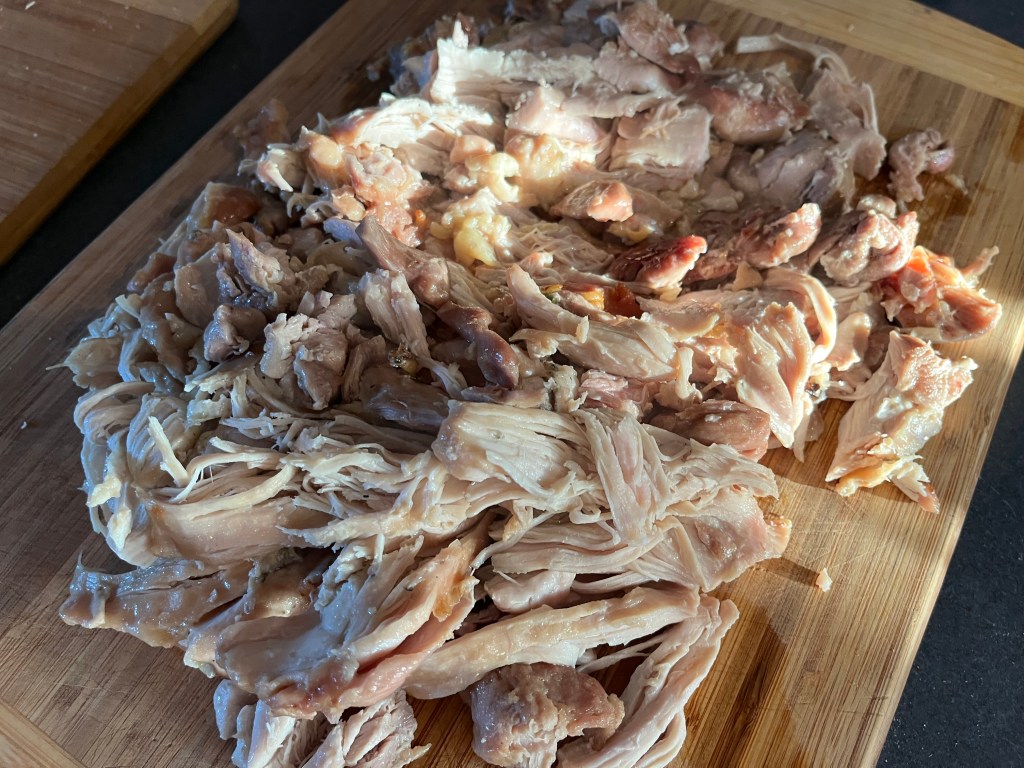
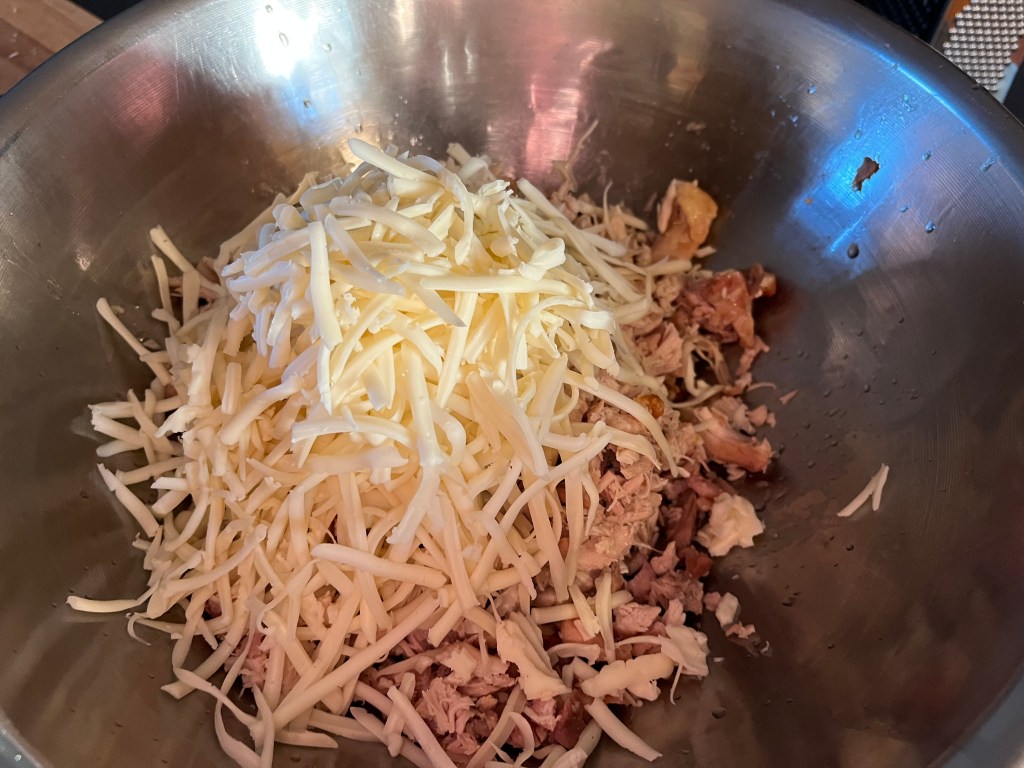
Shred the pork and mix with the braising liquid.
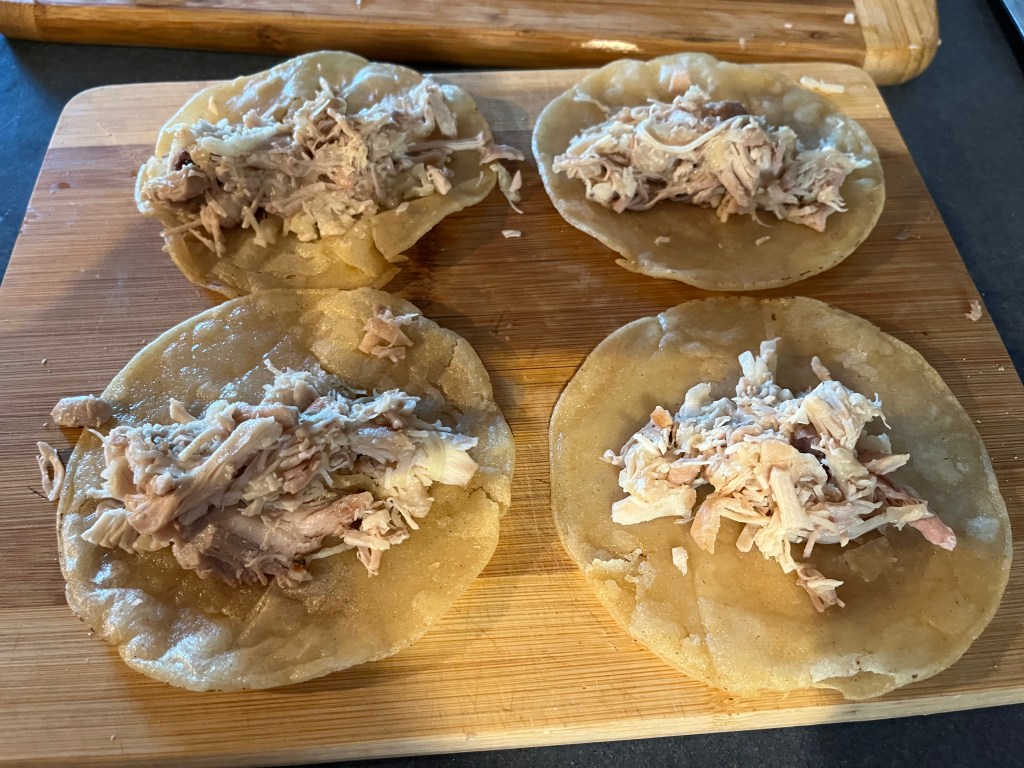
Serve on warm tortillas and add lettuce, tomato and onion.
Serve with fresh lime wedges and Tapatio hot sauce.
If you’re familiar with Tapatilo hot sauce, you might be wondering what looks different about this particular bottle. The regular image of the sombrero-wearing Tapatio has been replaced by comedian Gabriel ‘Fluffy’ Iglesias, along with Fluffy’s chihuahuas, to celebrate the 50th anniversary of Tapatio.
I don’t know why I’m making such a big deal out of this. It’s really just me prepping for dinner.
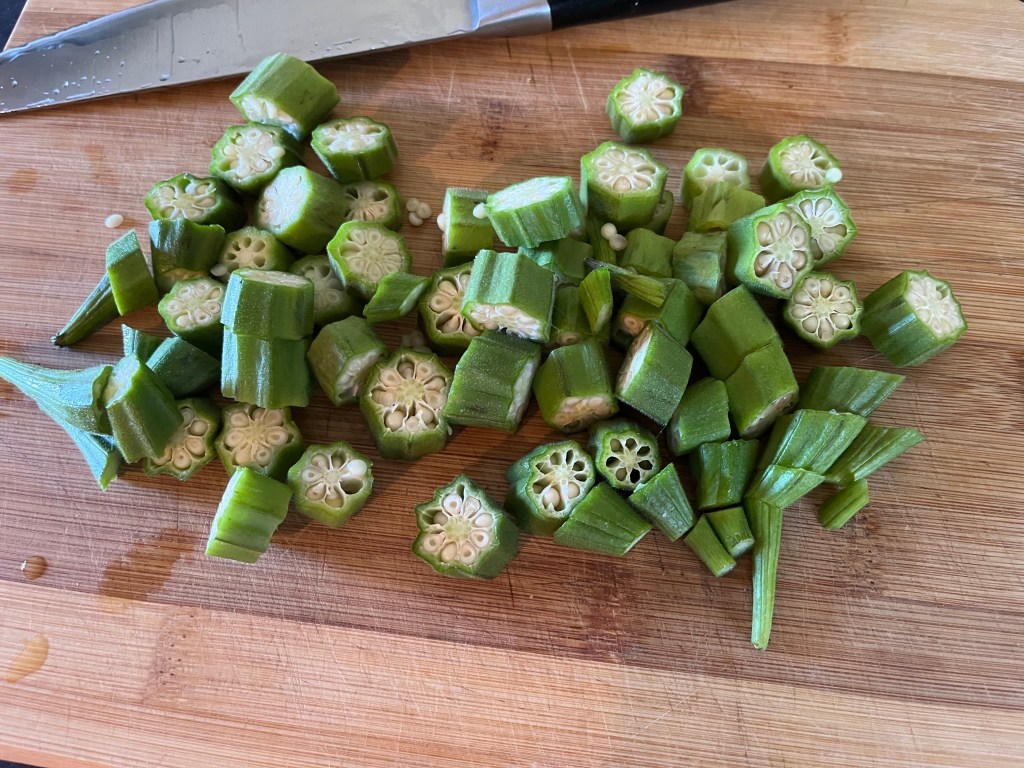
So, in case you were wondering what I was up to with onion, celery, bell pepper, garlic and okra, I’ll tell you.
It’s Gumbo, baby!
There’s no greater joy than making and eating a great gumbo. It’s also a little scary, but that just makes it more thrilling! Making a proper roux has been difficult and sometimes disastrous for me in the past, as I’ve mentioned at least once before in previous posts, but this time I took the training wheels off!
One thing that I love about gumbo is that it’s never made the same way twice. I should clarify. I don’t believe it should (or could) be made exactly, the same way twice. As one of my favorite local DJs says, on his “New Orleans Big Beat” radio program, “You never know what you’ll find in the gumbo. It might be jazz, funk, rock and roll, blues, or soul…it all goes into the gumbo!”
Gumbo is a soup/stew. The one thing that is essential in a gumbo is a roux and, if you are familiar with roux, you might be thinking of the butter, flour mixture that you whip up before adding stock, or milk, if you’re making a béchamel. It’s the basis of nearly every good sauce.
Gumbo roux is an entirely different critter. Traditionally speaking, a gumbo roux is made with vegetable oil or lard, or a combination of the two, and flour. Gumbo roux isn’t finished when the flour incorporates with the oil. It must be cooked to a point where it turns dark brown, to produce the desired flavor.
Once a year, or so, I put myself to the test and try to make a gumbo that can stand up to the good gumbos that I have eaten, over the years. With all modesty aside, I really nailed it this time!
Looking back on this particular gumbo experience, I would say that there were three key things that made the gumbo so tasty. First, I was wise enough to prep for the gumbo the night before I made it, as I mentioned in my last post. I could have pushed on and made the gumbo that night but, I didn’t want to make everyone wait for dinner and, my instincts told me to prepare some of the ingredients so that when it came time to make the gumbo, I wouldn’t be pressed for time or be stressed.
Secondly, I did what any great chef would tell me to do. I made a stock. I will describe how I made the stock later, but I assure you, it was the signature touch that not only made this gumbo different than ones I have made before, but it gave a depth of flavor that can’t be pulled out of can or a few bouillon cubes!
The final touch was the roux. As I said, I took the training wheels off and made a doggone roux the way it should be made. My previous attempts at making a roux involved nervously whisking oil and flour over a medium-low heat, trying to avoid the dreaded “burnt roux”. Cooking the roux at a lower heat resulted in 20 minutes of whisking only to wind up with a burnt roux. I was too timid. I’ve seen people make roux and the process should only take about 10 minutes.
You might be thinking, “how do you know if a roux is burnt?” Well, all I can say is smell it and be honest with yourself. If it smells burnt, it’s burnt, and there’s no turning back. Throw the roux out and start all over again.
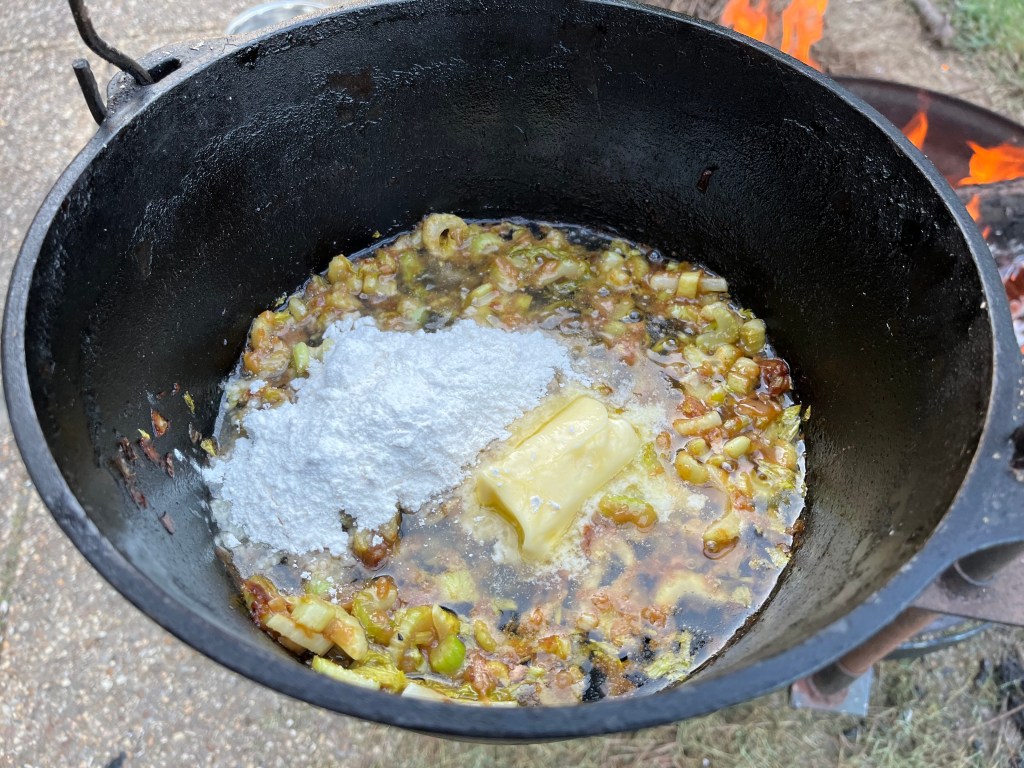
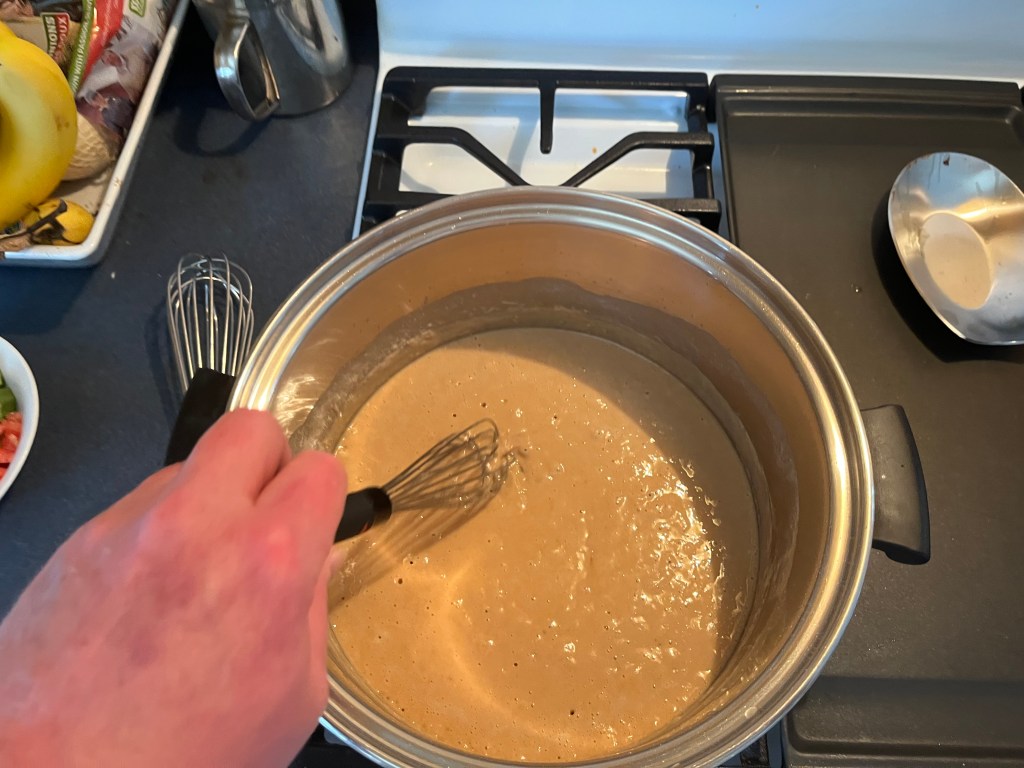
This time, I added the oil to the pot and turned the heat up high. Not maximum, killer-high, but high. I let the oil get very hot and then I added the flour, all at once. The flour began to brown instantly, and even though I wanted to take some photos during the process, I had to keep whisking furiously. I turned the heat down to medium-high and whisked until my wrist was about to give out. Seven minutes later, I had a deep, dark roux. I turned the heat off and transferred the roux to another bowl, to stop the heating process and give the roux a chance to cool down.
The good thing about a dark roux is that it makes a rich gumbo. The downside about a dark roux is that it won’t thicken a gumbo as much as a lighter, blonde roux will. Big deal. I’ve got fresh okra!
The origin of the word gumbo comes from Africa, and it refers to okra, which brings me back to the memories I have of my first visit to New Orleans. The wonderfully diverse city of New Orleans, and the surrounding areas, owe its alluring charm to the many cultures that has made it what it is today. Africans, Acadians, Spanish, Native American Choctaw and just about every other nationality and culture you can think of helped build New Orleans. The list of immigrants continues with Germans, Mexicans, Caribbean Islanders, Chinese, Jewish, Vietnamese, Italians…I’m not making this up! When people speak of American as a “melting pot” of cultures, they shouldn’t just think of big cities like New York or Chicago. New Orleans was founded by and supported by a mélange of people and cultures. It is truly a remarkable city, and New Orleans is a testament to the notion that a diverse population is a beautiful recipe for a community.
Ingredients:
16 medium whole, fresh shrimp
3 Chicken thighs (bone-in, skin on)
½ bell pepper, chopped
1 large tomato, chopped and divided
1 large sweet, white onion, finely chopped
1 large bell pepper, finely chopped
4 celery stalks, finely chopped
2 or 3 garlic cloves, mashed and minced
½ lb. andouille sausage, cut into ½” pieces
2/3 cup vegetable oil (I used canola oil)
1 ¼ cup all-purpose flour
64 oz chicken broth (8 cups)
6 oz fresh okra, cut into ½” pieces
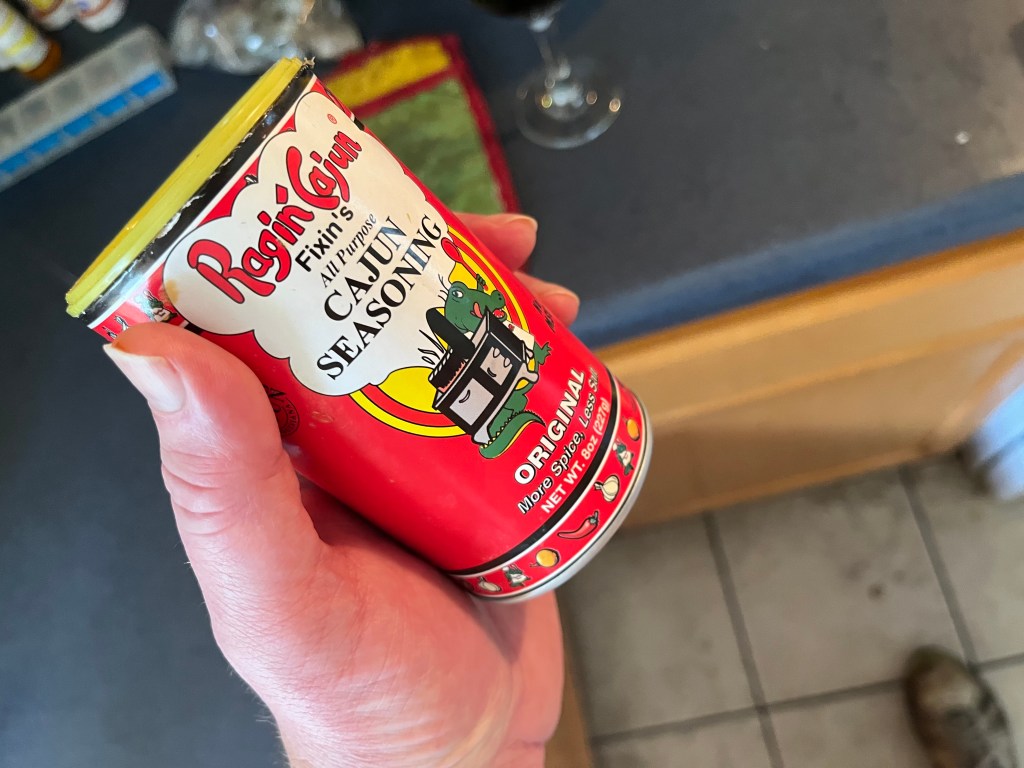
3 Tbs Cajun seasoning
Several sprigs of fresh cilantro (for garnish)
Directions:
Chop onion, bell pepper, celery and garlic. Mix the vegetables in a large bowl and set aside.
Peel the shrimp. Reserve the heads and shells. Set shrimp aside.
Rough chop ½ bell pepper and set aside.
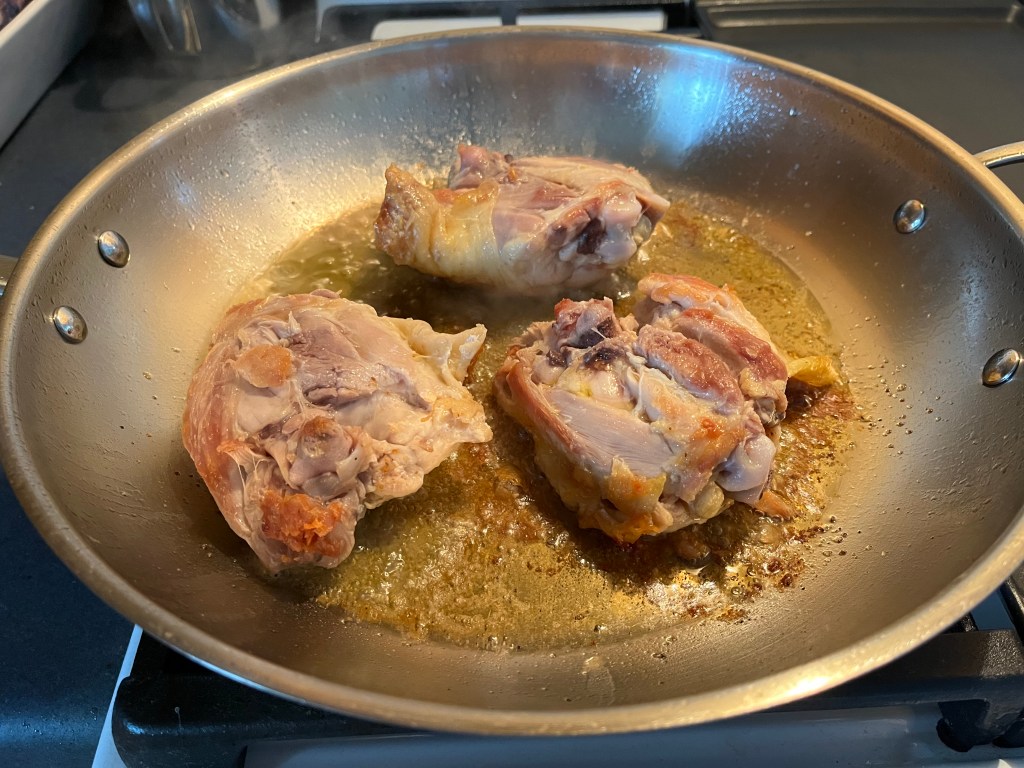
Add about 1 tablespoon olive oil to a skillet. Set heat to medium/high and add the chicken breasts to the skillet, bone side down. Cover and simmer for 15 to 20 minutes.
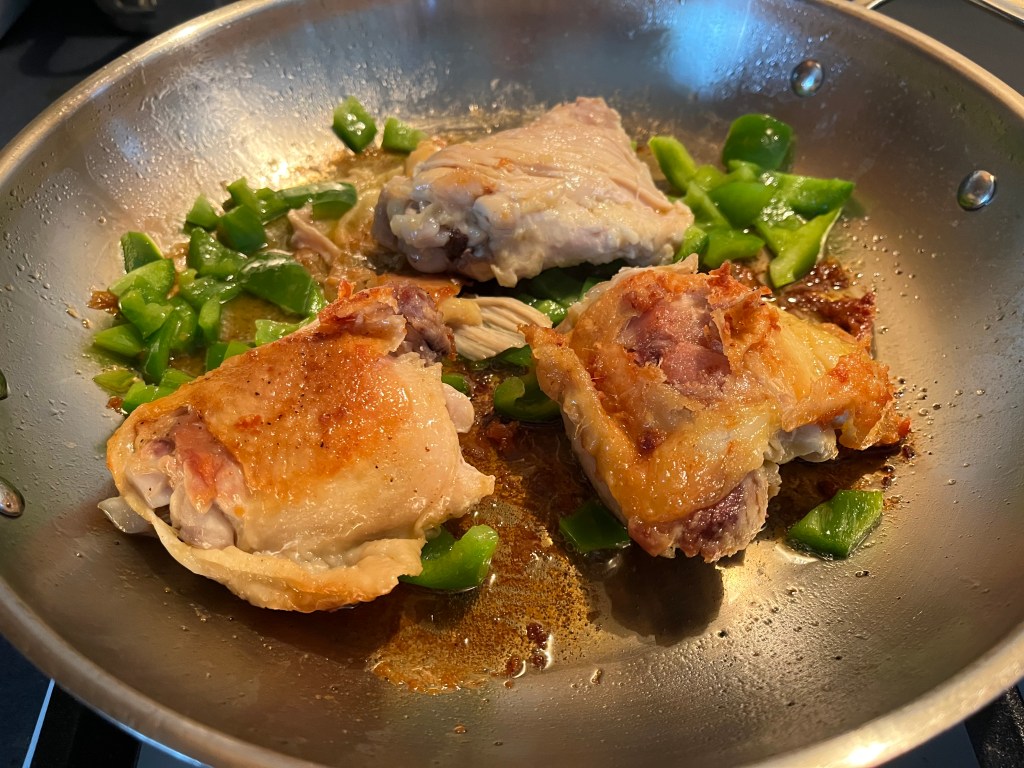
Turn chicken over and sear, skin side down, for 15 minutes. Turn the chicken over again and add half of a bell pepper, chopped. Simmer for 5 minutes, or until the bell pepper softens.
Remove the chicken, separate the crispy skins and return the skins to the skillet. Set cooked chicken aside to cool.
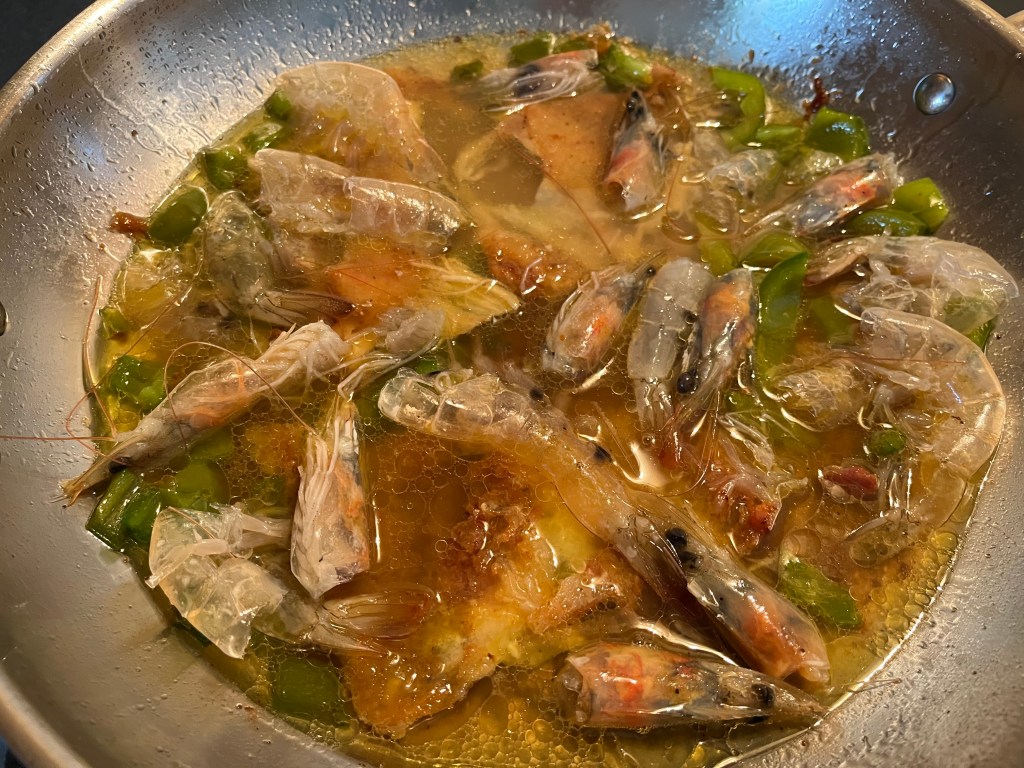
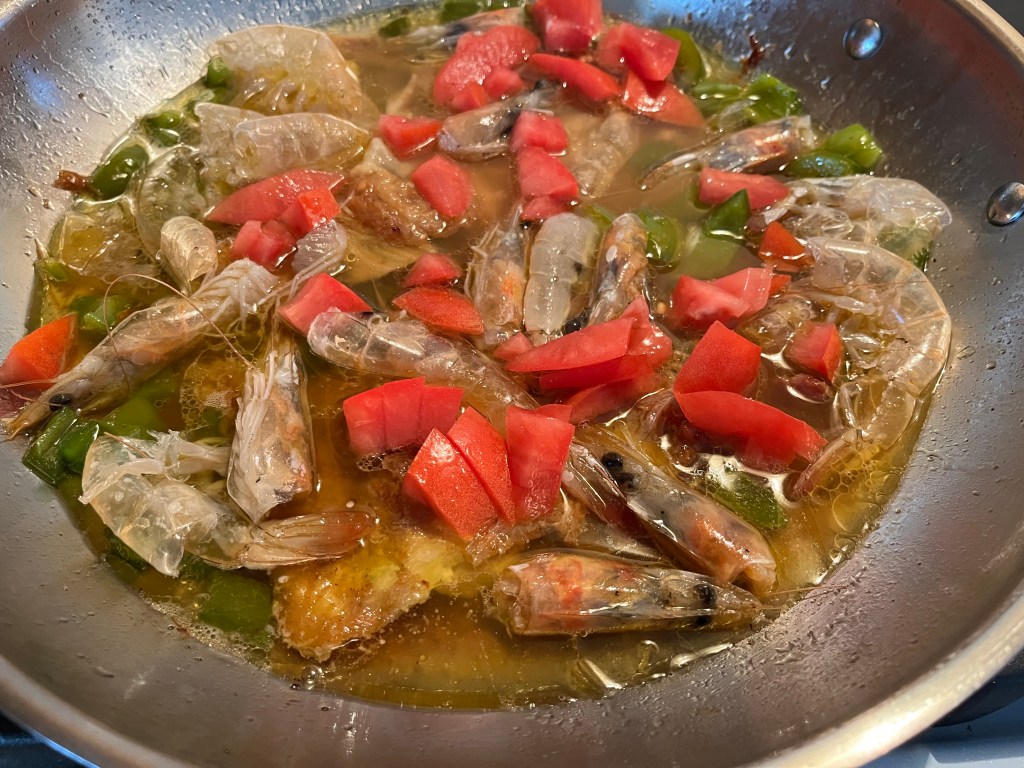
Add the shrimp shells and heads to the skillet. Add 1 cup chicken broth and half of the chopped tomato. Cover and simmer at low heat for 20 minutes.
Remove the cover from skillet and mash the softened shrimp heads. This is not the time to be squeamish. Just remember, you’re using every part of the shrimp, which is honorable, and you will be rewarded with a very tasty sauce. This is a must!
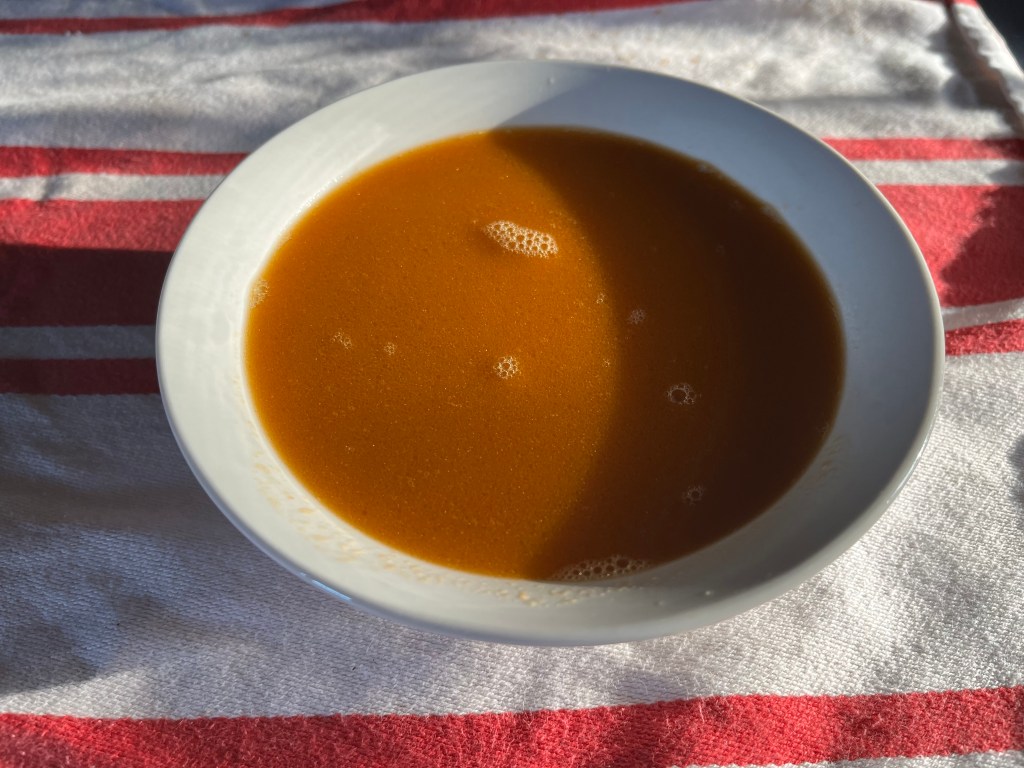
Simmer uncovered at medium heat for another 10 minutes, to reduce the stock. Pour the stock through a strainer and reserve the finished sauce. This will make about 1 ½ cups of sauce.
Taste a little of this sauce. It’s a glorious shrimp consomme!
I’m not kidding when I say that I’d be happy just to sit at a table and slurp down this stock and forget about making the rest of the meal. It’s that good! But, I know what this relatively small amount of sauce is going to contribute to the gumbo.
After a few moments of enjoying the aroma of the sauce, and dreaming about consomé de camarón, I was ready to get back to the action.
Add a teaspoon of cooking oil to a large stock pot. Put the pot on the stove and set heat to medium/low.
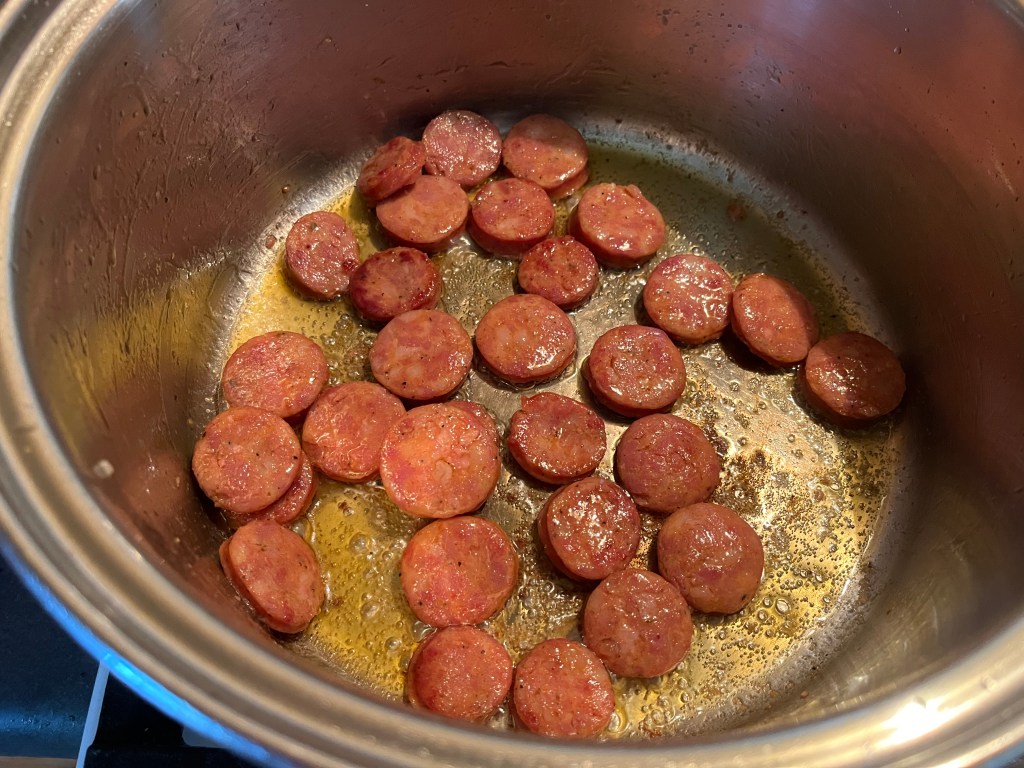
Slice the andouille sausage and add to the pot.
Sear the sausage, without stirring, for a few minutes.
Briefly stir and continue to sear the andouille until the sausage browns slightly. Remove the andouille and reserve the oil in the pot.
Add the chopped onion, bell pepper, celery and garlic to the pot. Cook at medium heat, stirring frequently for 10 minutes, or until the onion begins to turn translucent. Remove the vegetables to a bowl and set aside.
Remove the bones from the cooled chicken thighs. The bones should easily pull away from the chicken. Chop the chicken and set aside.
Now, go back to the large pot that was used to cook the vegetables. Wipe the pot dry with a paper towel, to prepare for making the roux. You don’t want to add oil to a wet pot! Add 2/3 cup vegetable oil to the pot. Turn heat to high.
Once the oil is hot, add the flour, all at once. The flour should begin to brown as it hits the oil. Don’t panic. Quickly whisk and reduce the heat to medium/high.
Keep whisking as the flour incorporates with the oil. Over the span of a few minutes, you should see the roux turn from blonde to tan. Keep whisking and scraping the sides of the pot with the whisk, occasionally. Let your nose guide you as you whisk. The aroma should smell something like roasted nuts, or toasted sesame seeds. The color of the roux should go from tan to dark mahogany. At this point, reduce the heat a little and bring the roux up to a dark brown. Again, let your nose guide you. If you think that the toasty aroma is approaching anything that might be considered burnt, shut everything down.
Turn the heat off and remove the pot from the stove. A roux does not have to be chocolate brown to be good. I’ve stopped at blonde before and have still enjoyed the final product. This roux wound up being the color of dark, milk chocolate.
As I mentioned earlier, this was the first time I made a roux using high heat. It came together quickly. I transferred the roux to a bowl, to stop the heating process. After the roux cooled a little, I carefully tasted it. Be very careful when tasting a roux. It’s as hot as lava. There was a slight hint of flour when I tasted the roux, which told me that I would want to simmer the gumbo for a long time.
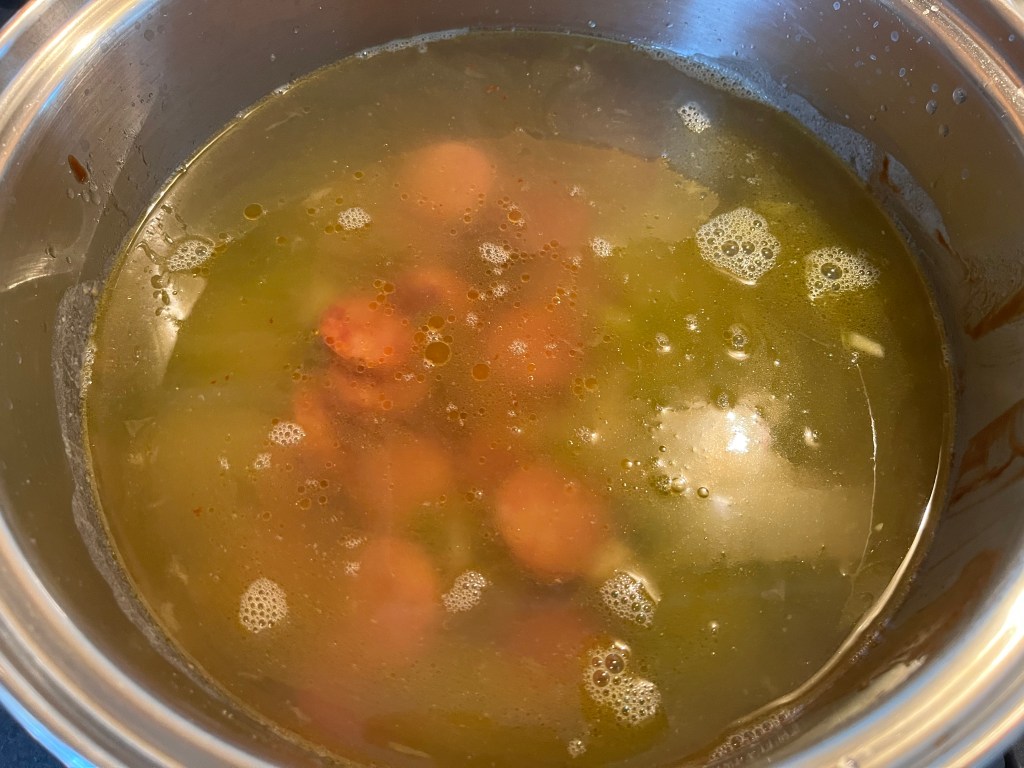
Add the remaining chicken broth (7 cups) to the pot. Turn the heat to medium/low and stir, mixing the residual roux with the broth.
Add the cooked vegetables.
Add the andouille.
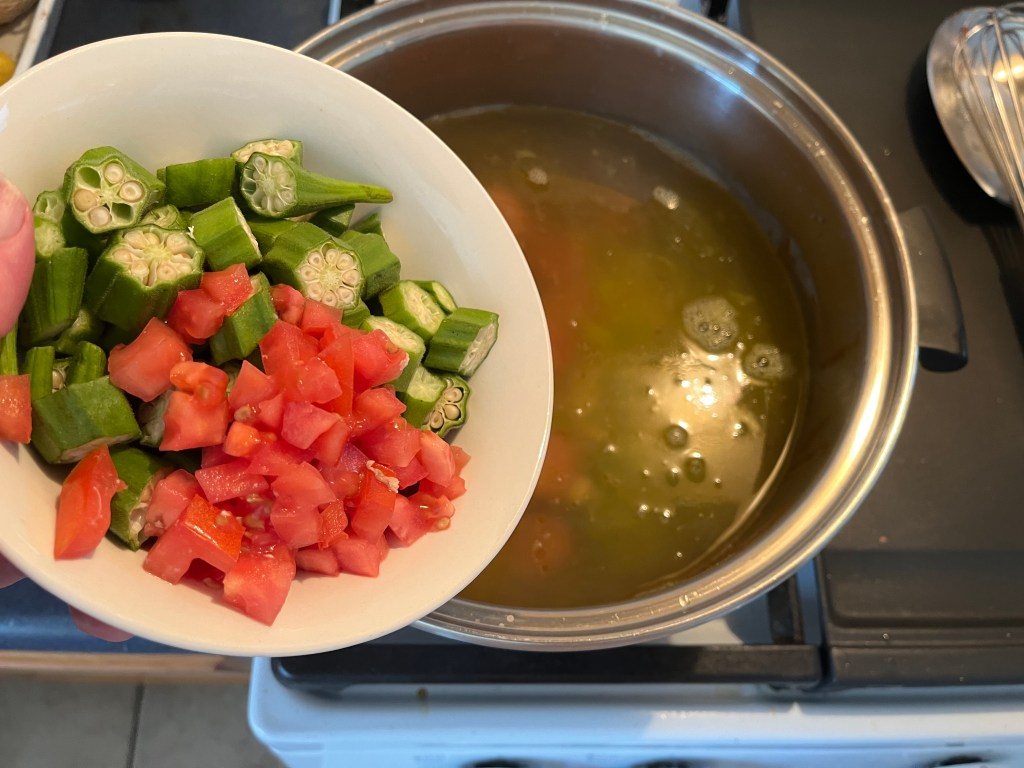
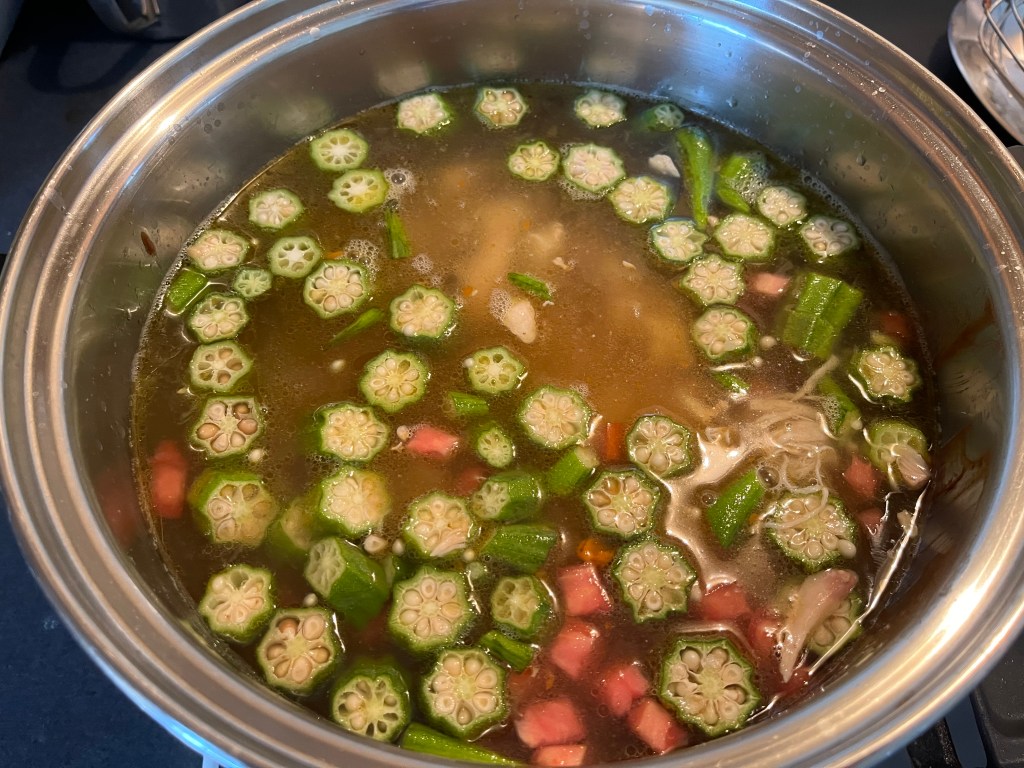
Add the okra and remaining chopped tomato.
Okra is a natural thickener. A dark roux is more flavorful than a light roux, but a dark roux will not thicken a gumbo as much as a light roux. Okra can make a soupy gumbo thicker, like a stew.
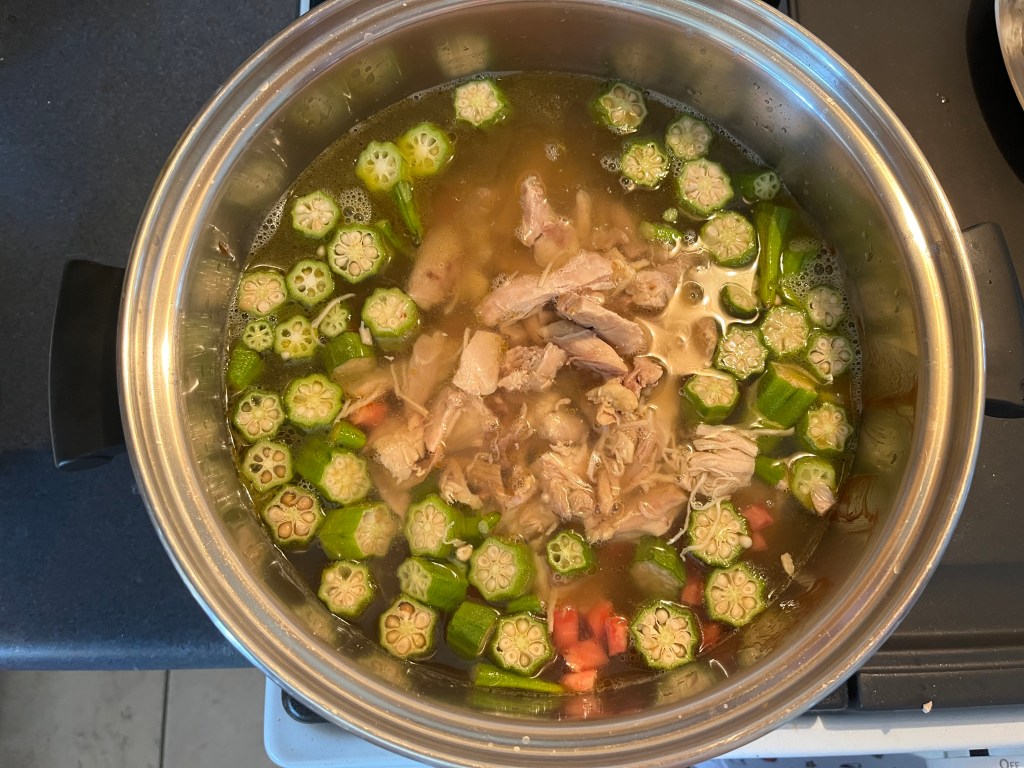
Add the chopped chicken.
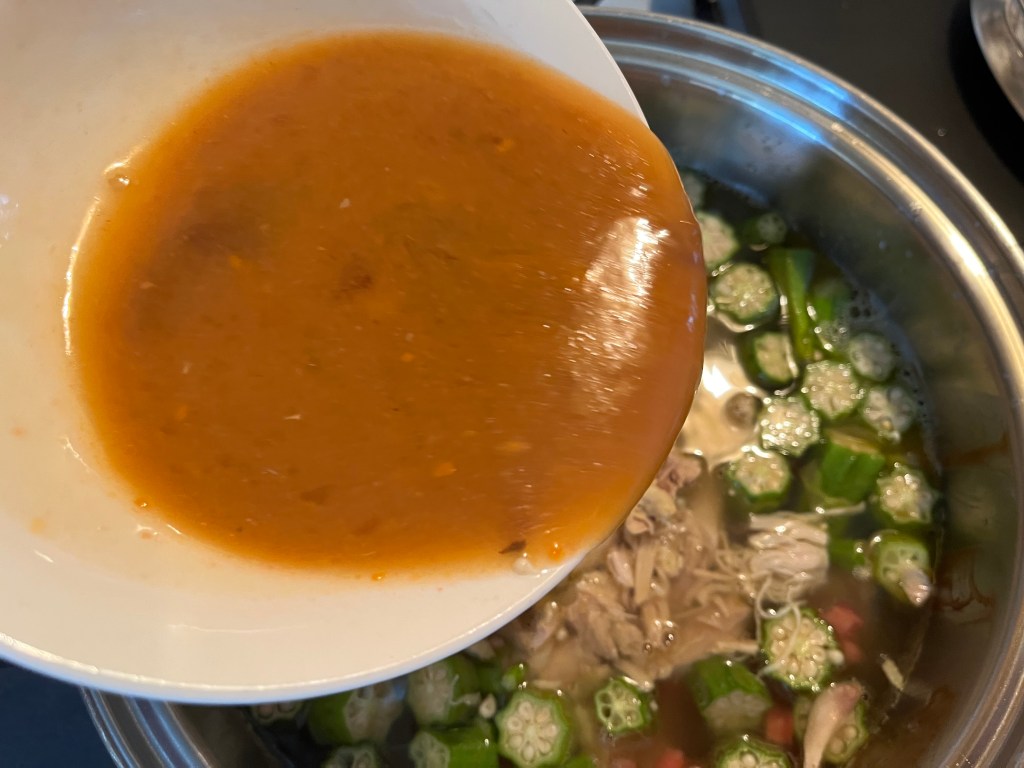
Add the incredible shrimp sauce.
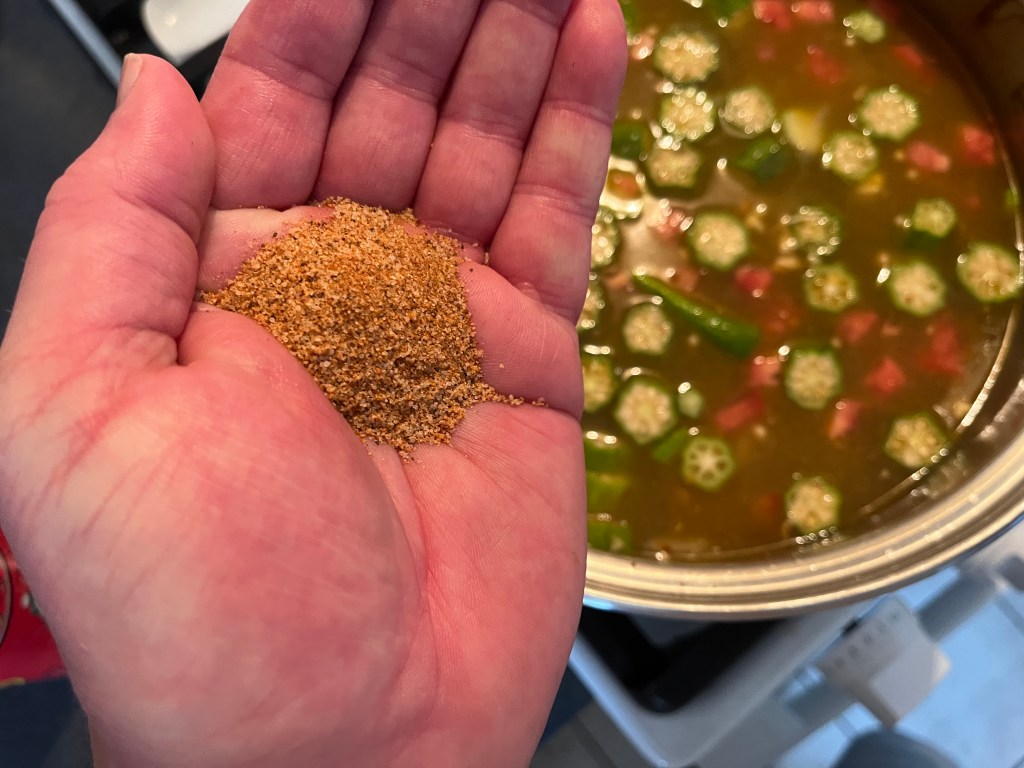
Add 3 tablespoons Cajun seasoning.
Add the roux. Stir gently to blend in the roux.
Turn the heat down to low and simmer, uncovered, for an hour to and hour and a half.
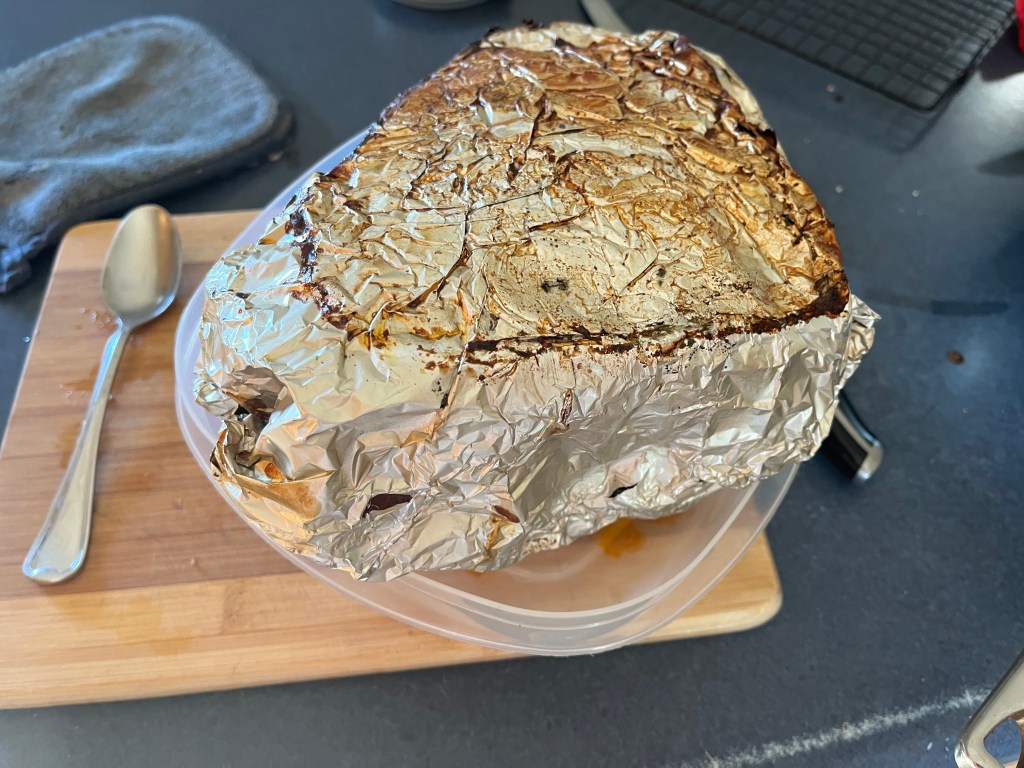
Remember, back at the beginning of this post, when I said that you never know what you’ll find in the gumbo? Well…while the gumbo simmered on the stovetop, I was also finishing a smoked pork shoulder roast in the oven. A few days earlier, I applied a dry rub to the pork roast and smoked it outdoors for about eight hours. It was a cool and windy day, and it was difficult to maintain the proper heat in the smoker, so the roast needed a little more time to finish. I wrapped the roast in foil and put it in the refrigerator and brought it back out while I was making the gumbo.
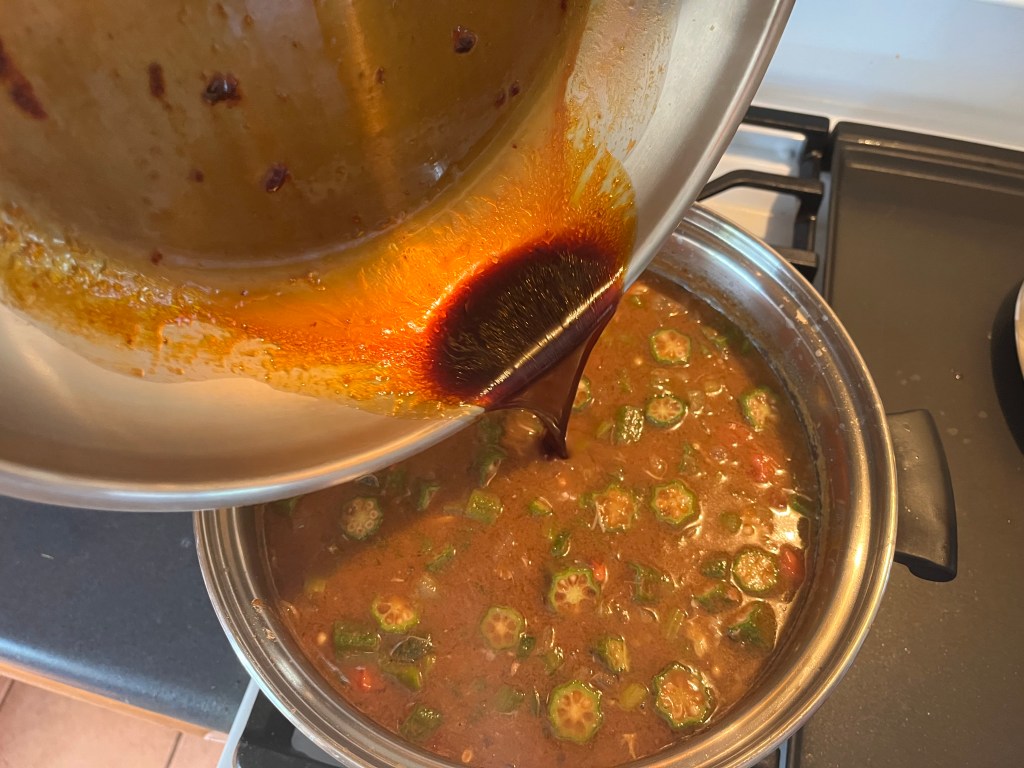
The wrapped pork should slow-roasted for two hours in the oven and, when I pulled it from the oven, I saw that some of the juices escaped the foil wrap and left a sticky glaze on the pan. I added a little water to the residue and whisked it. That produced a smokey, spicy sauce that just had to go into the gumbo!
Add the shrimp and simmer for another 20 minutes. The gumbo is ready to serve.
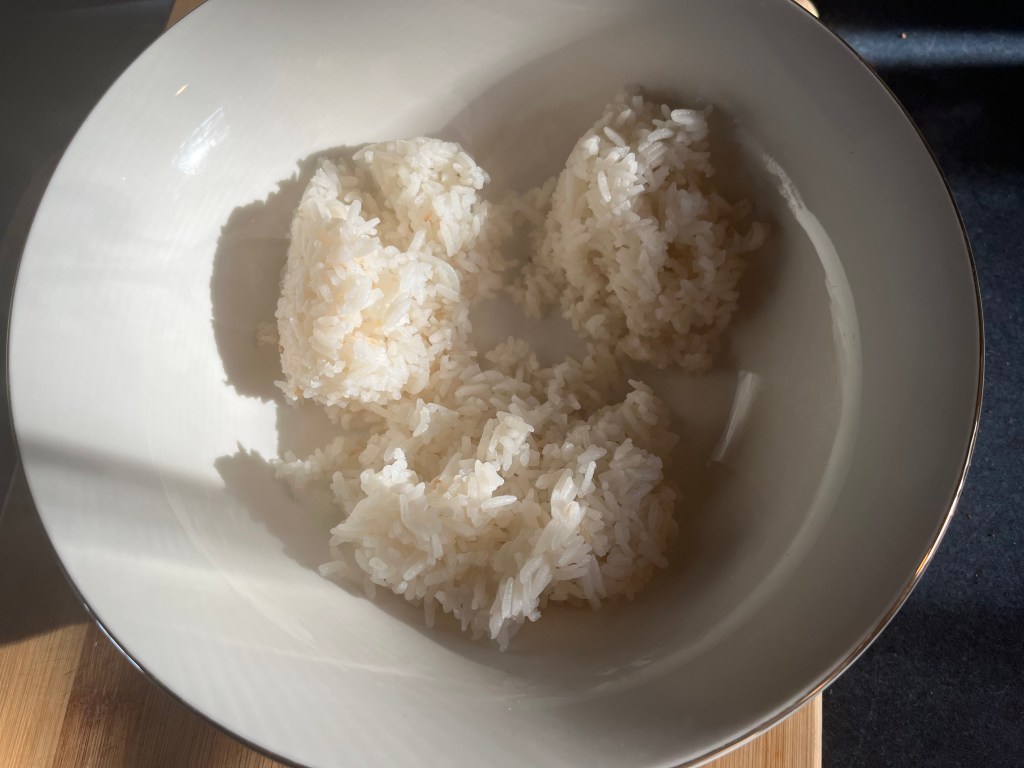
White rice completes the dish.
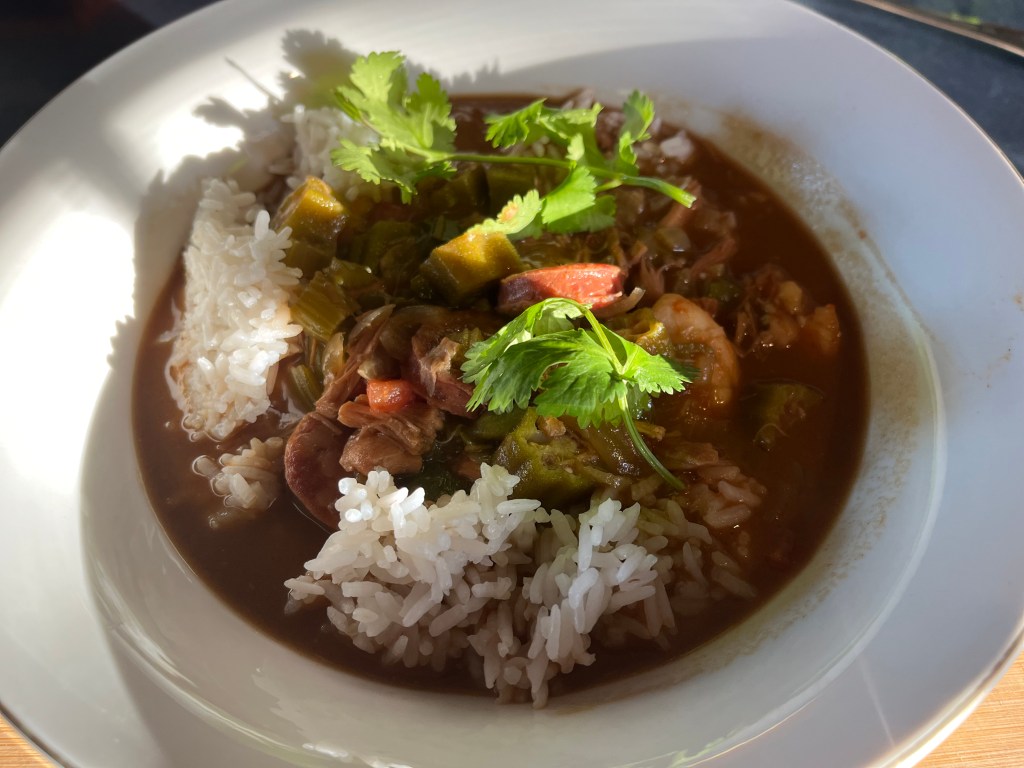
Top the rice with a healthy portion of gumbo and top with cilantro.
I’ll never be able to replicate this gumbo recipe, and I’m fine with that. There will be other gumbos to come, and they will have their own special place in my heart.
Eat well and eat with your family and friends every chance you get!
In case you are interested, the radio program, “New Orleans Big Beat” is presented by volunteer radio station, WEVL, in Memphis, TN. Check out their diverse and eclectic programming schedule here: wevl.org
Sometimes a pot needs to simmer. Sometimes meat needs to rest before it is sliced. Sometimes words need to be arranged just so, like silverware on an elegant table.
This is one of those moments.
What began as a silly game of “Guess what I’m making for dinner” has turned into something more than I expected.
So, for now, I will leave another clue. And, if you can’t put two and two together and arrive at four, that’s your own fault!
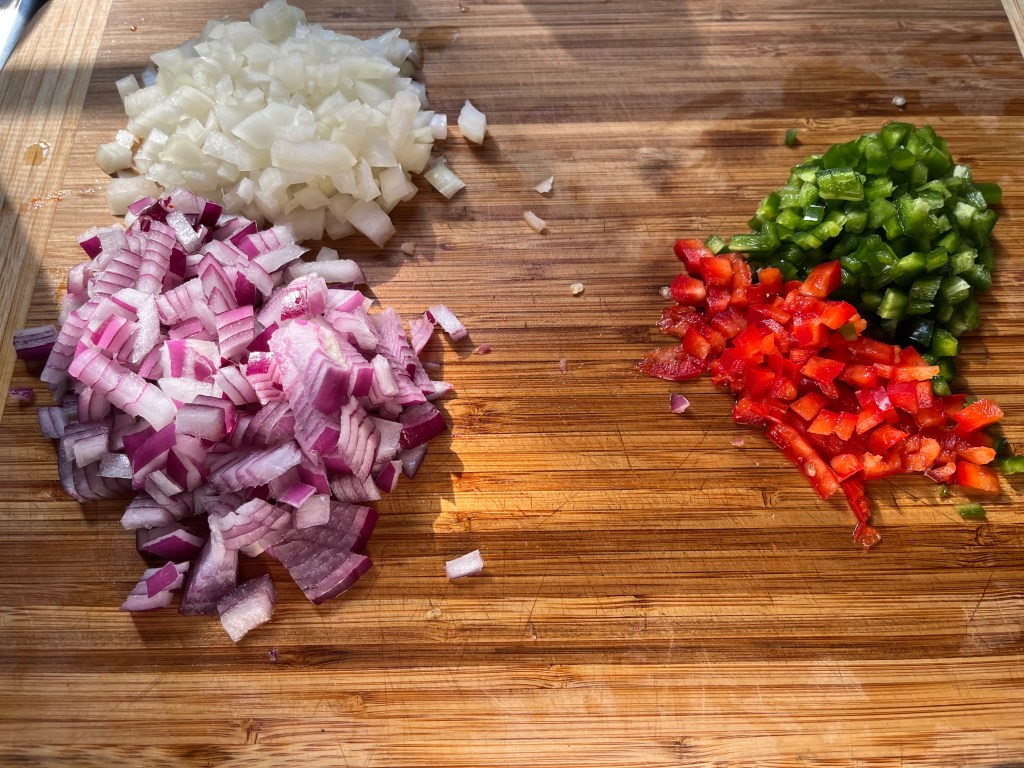
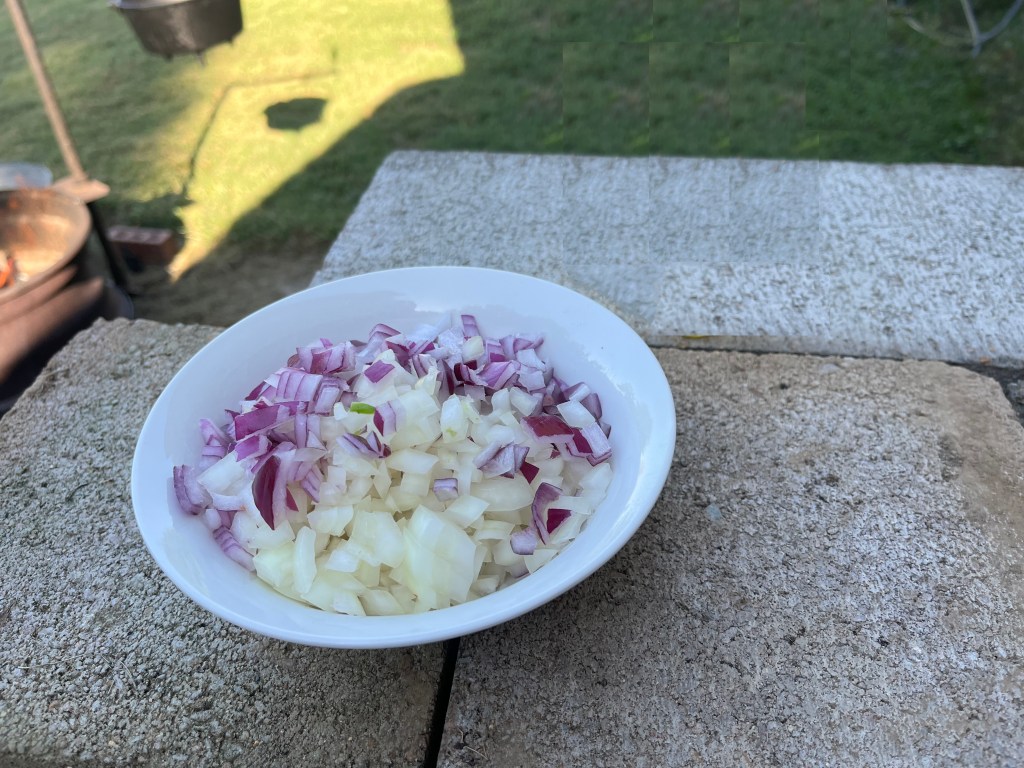
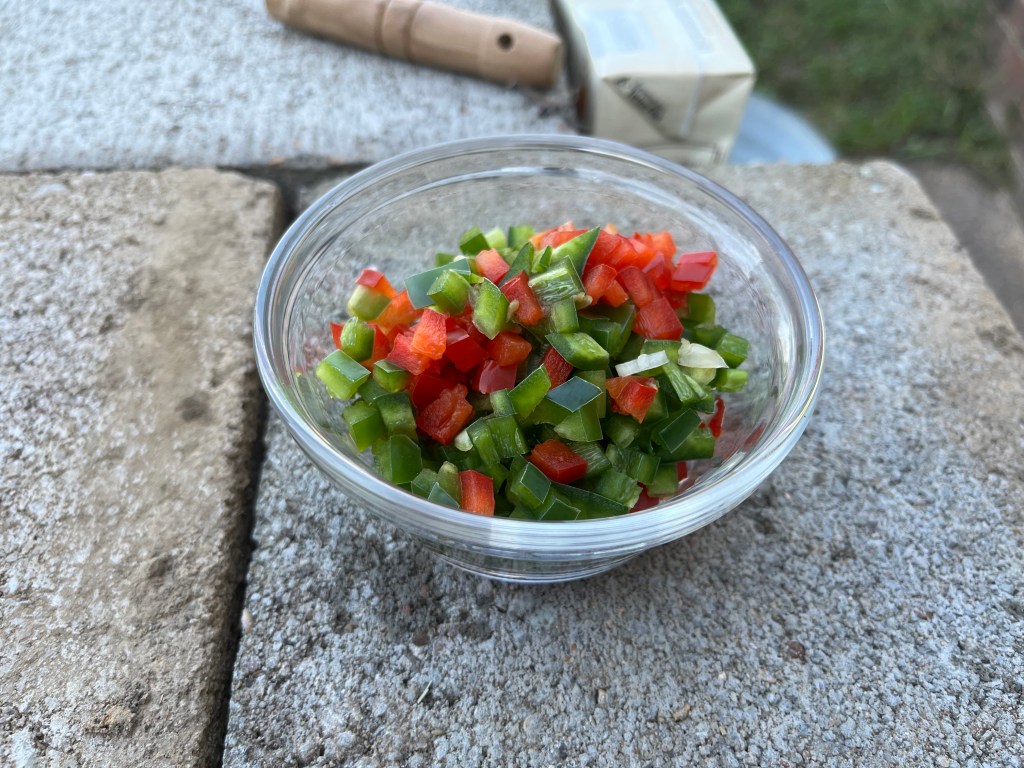
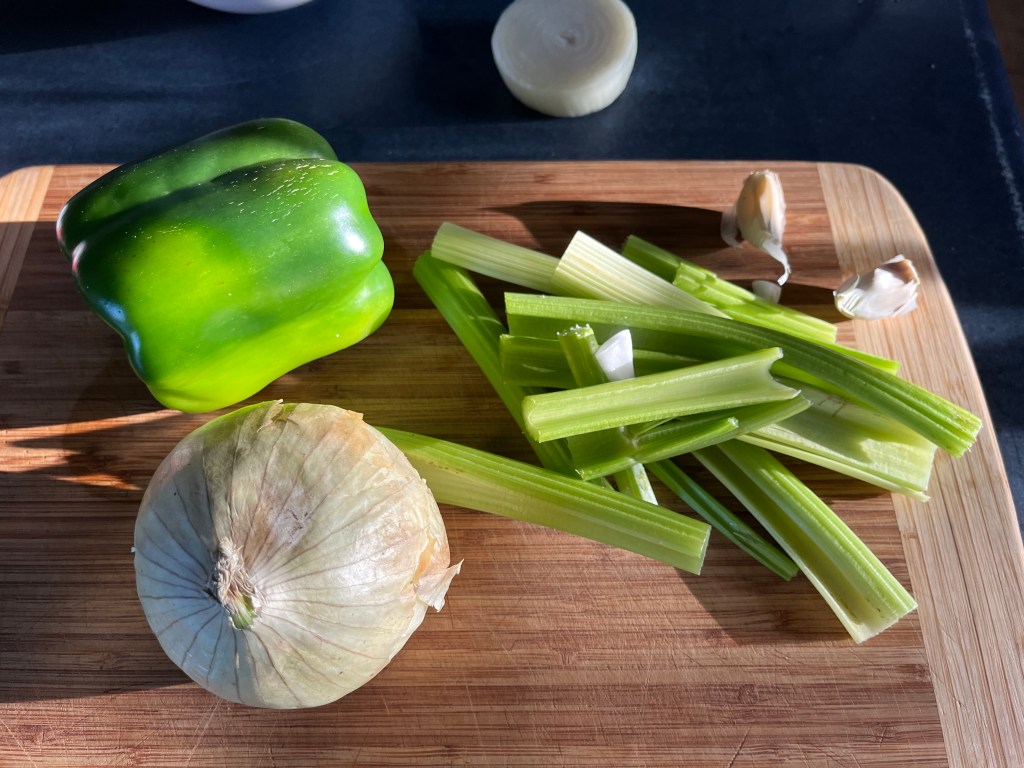
Take a look at these items and tell me what I’m making for dinner.
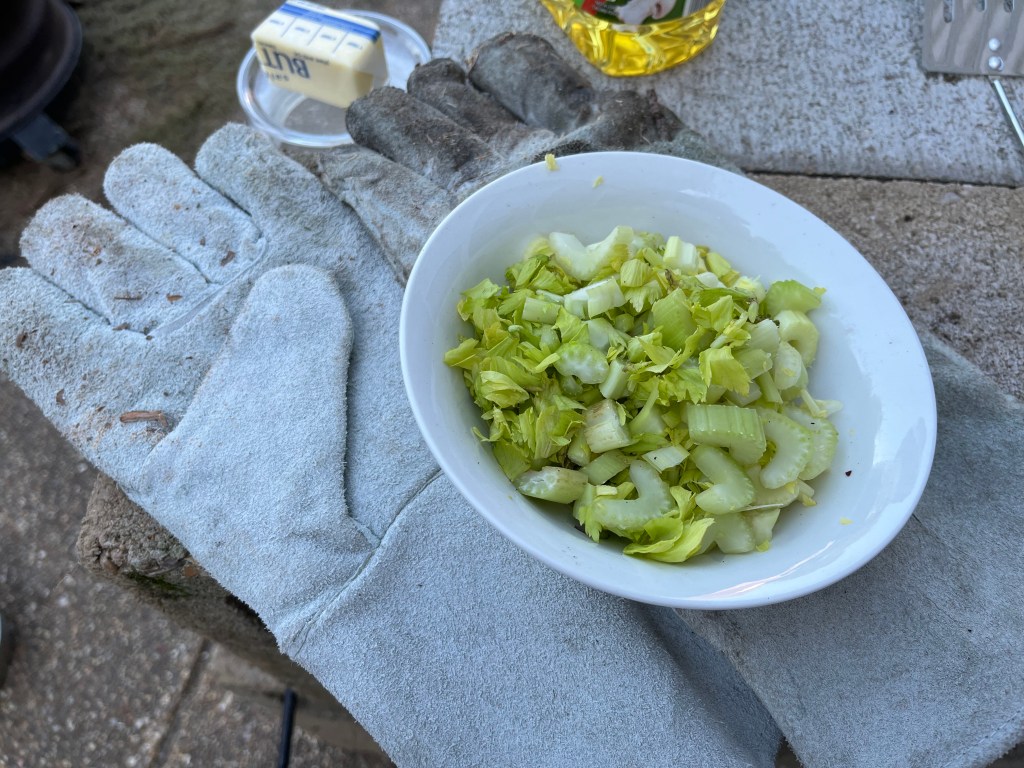
Hmmm…that looks like bell pepper, celery, onion and garlic. Well, those are all common items found in lots of recipes but, if you know me well enough, you’ll be able to guess what I’m up to, right away.
Do you want a hint?
Maybe this accidental shot of my hand beneath the cascading sunlight will give a clue…
OK. Do you need another hint?
Sorry, no more clues. Let’s jump to the finished product.
If you guessed meatloaf, you’re only partially correct.
This meatloaf contained onion and a few slices of bell pepper on top, but it didn’t have any celery or fresh garlic in it.
So, what gives?
Here’s the deal. I planned on making one of my favorite meals and I realized that time was running out. So, I spent my time wisely. My first step was to continue prepping some of the ingredients for the meal that I REALLY wanted to make while going to a backup plan, at the same time. This is something I have learned over the years. Just because I want to make something wonderful and delicious, I might not have the time to pull it all together in time for dinner.
Enter meatloaf. (RIP Michael Aday)
Meatloaf is one of those things that can be thrown together quickly, and it can be made with all sorts of ingredients. I like to use ketchup, as well as dehydrated onion flakes, Worcestershire sauce, a little soy sauce, a dash of hot sauce, a couple of eggs, some dry oats, and salt and pepper to taste. I drizzled some barbecue sauce over the top of this one, just for grins.
I think most Americans would serve this with mashed potatoes and a steamed or sauteed vegetable dish on the side, but I decided to make put a twist on a traditional salad.
In case you’re interested, here’s an approximated recipe for the meatloaf. I was serious, when I said that time was of the essence. I didn’t measure anything.
Ingredients and Directions:
2 lbs 80/20 ground beef
2 eggs
1 ½ cup dry oats
1 Tbs Sriracha sauce
2 Tbs Worcestershire sauce
1 Tbs soy sauce
Combine the following in a mortise and pestle: 3 tsp dried onion flakes, 1 tsp salt, 1 tsp cracked black pepper, 1 Tbs seasoning salt, 1 Tbs Cajun seasoning. Grind to a powder.
Mix all of the ingredients thoroughly and press into a casserole dish.
Lay a few rings of bell pepper on top and zig-zag some barbecue sauce on top.
Bake in a 350° oven for 1 hour.
Serve warm.
Dinner was served and I was able to prepare for the next night’s meal. Win – Win!
Over the last several years, I have seen “Cheese Fries” or “Cheesy Fries” appearing on several restaurant menus. I have to admit, I get a little grossed out when I think about Cheese Fries.
I like French fries and I like melted cheese, but do I want gloopy cheese glopped on top of my French fries? – – Heck, no! Most Cheese Fries recipes call for melted processed cheese, which is fine for ballpark nachos, but I don’t want that gloopy mess on my French fries.
Despite my ranting about the utter wrongfulness of cheese fries, I’m not totally insensitive to people’s cravings, even if those cravings might lead them down the perilous path of gluttony!
So, with that, I tip my hat to the Cheese Fries lovers and offer them something I deem worthy.
Ingredients:
6 medium sized russet potatoes, peeled and cut, French fry style, ¼’ thick sticks
1 ½ cups canola oil (or just enough to cover the potatoes in the skillet)
Seasoning salt to taste
3 Tbs. olive oil
1 lb. raw, deveined shrimp (tails on or off)
3 Tbs butter
6 cloves garlic, mashed
1/3 cup roasted bell pepper, chopped
1/2 cup chicken broth
1 1/2 cups half-and-half
Salt and pepper to taste
1 cup grated Parmesan cheese
½ cup grated Swiss cheese
Directions:
Peel and cut the potatoes. These can be ¼” French fries or thick steak fry wedges.
Soak the potatoes in cool water to remove some of the starch. Strain potatoes and air dry for several minutes.
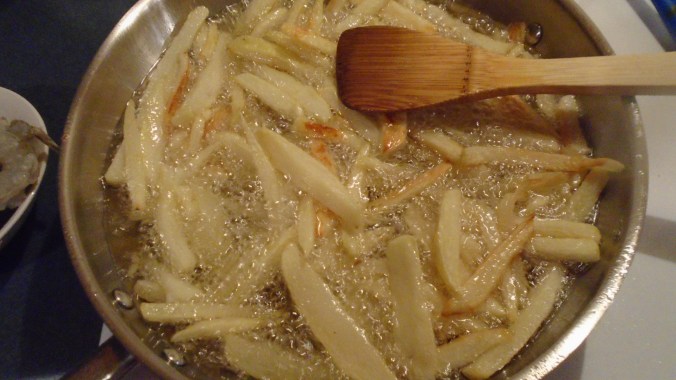
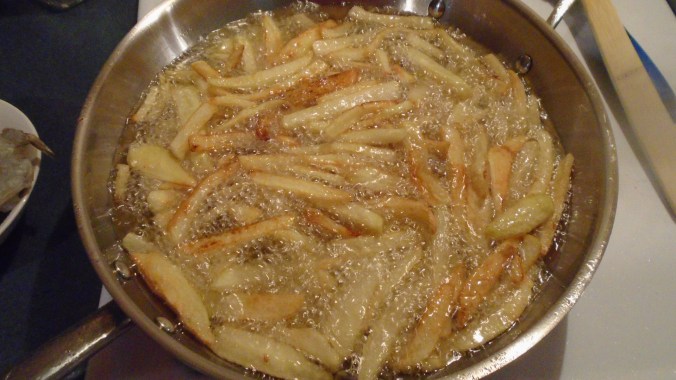
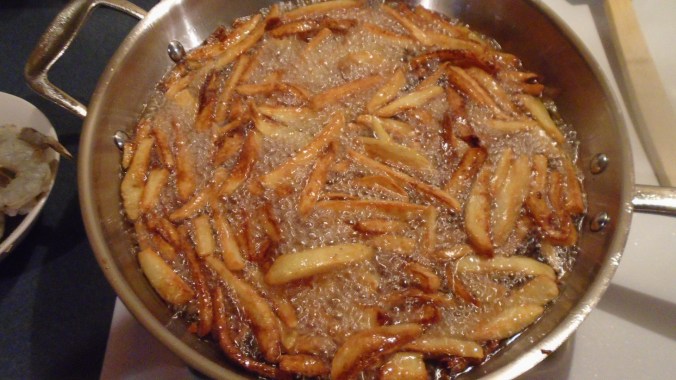
Fry potatoes to golden brown. Remove and strain. Return the hot oil back to the skillet. After a minute, add the fries back to the hot oil and fry for another minute, to crisp.
Put the finished fries in an bowl and keep in a warm oven.
Remove most of the oil from the pan and reserve a few tablespoons. Set heat to medium. Add shrimp. Turn shrimp over after two minutes and cook for one more minute.
Remove shrimp to a bowl. Set aside.
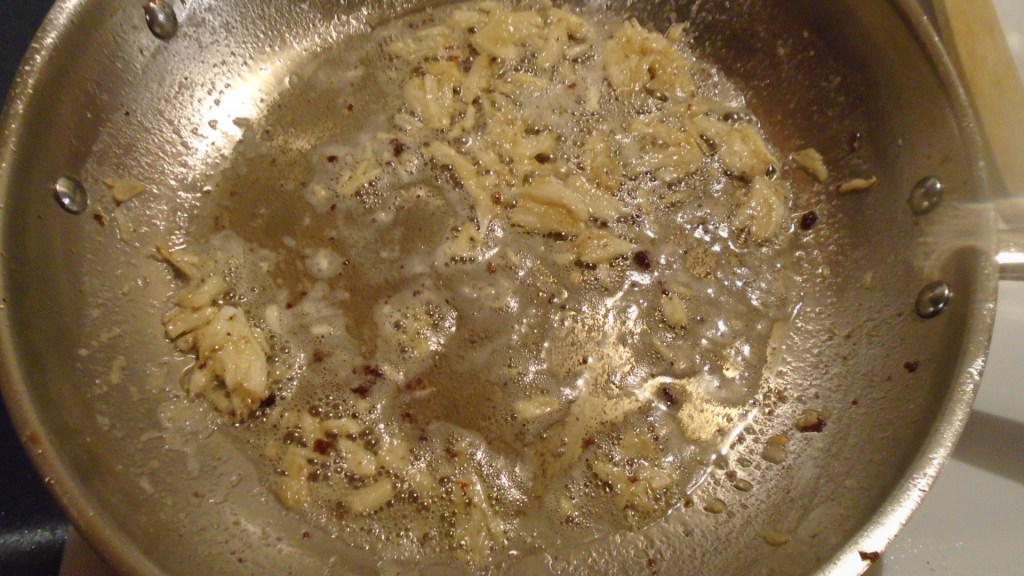
Melt the butter in the skillet and sauté the garlic over medium heat for a minute.
Add the chicken broth and reduce the sauce by one half.
Add roasted bell pepper.
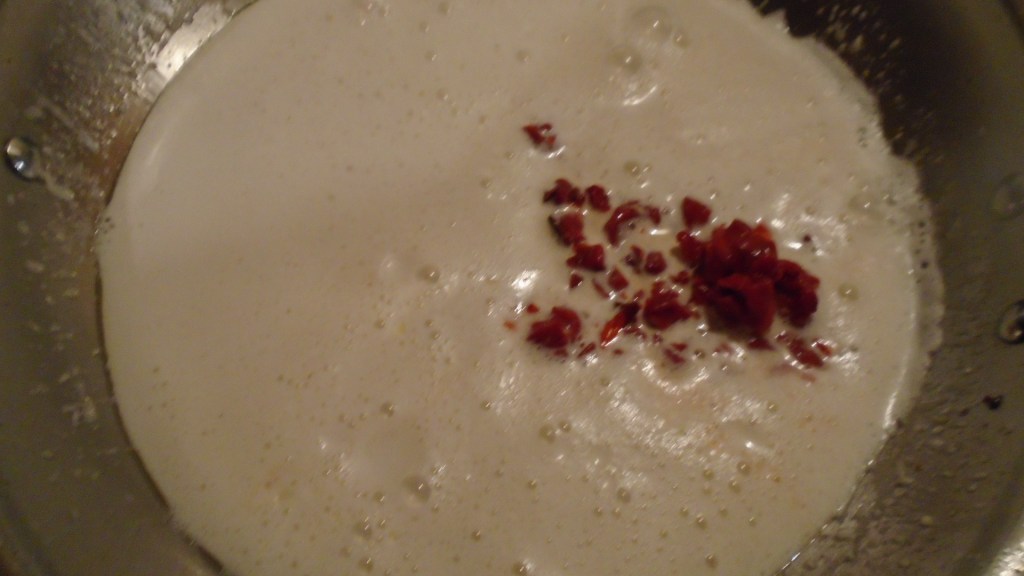
Add half-and-half and simmer at low heat for a few minutes. Add salt and pepper to taste.
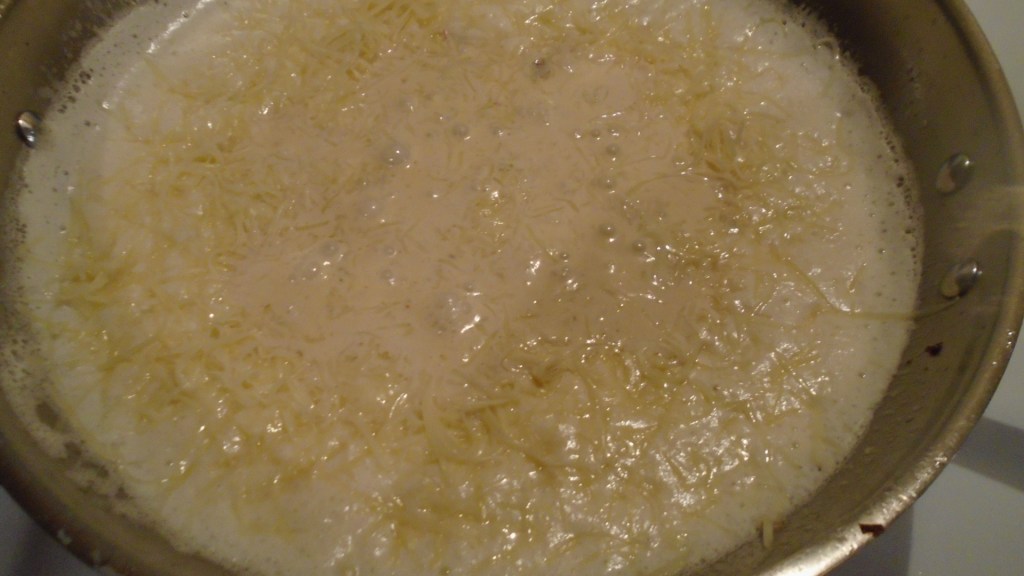
Sprinkle the grated Parmesan and Swiss cheese over the sauce and simmer, at low heat, without stirring, for a minute.
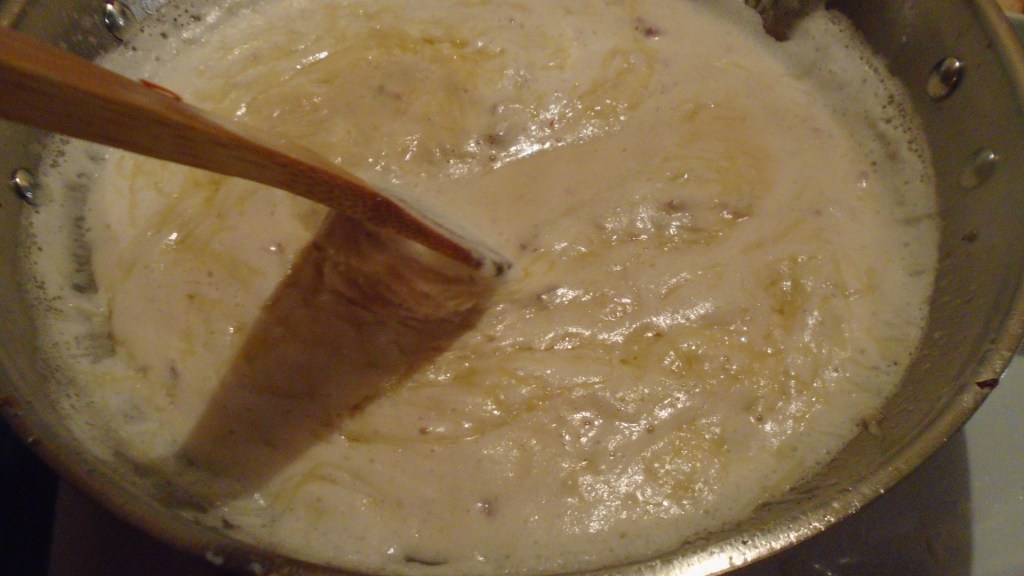
When the cheese melts, turn the heat off.
Add the cooked shrimp to the sauce.
Add warm fries to serving bowls. Cover the fries with the creamy shrimp.
Serve with a cheesy movie!
May I suggest, Mystery Science Theater 3000: “The Magic Sword” ?
I like stuffed pork chops but, it seemed that every time I made them I over-baked them, to the point where they were dry and tough and the stuffing fell out of them while they baked. I butterfly cut the chops, making a long, deep cut into the meat, which made them easy to stuff but, not very pretty when they made it to the table.
This recipe calls for piercing a small hole into the side of the pork chops and maneuvering a knife inside of the chops to create a large cavity. The pork chops were seared on both sides and then baked in the oven, covered, to help keep the meat moist and tender.
Prep time can be reduced, if you are in a hurry, by using prepared breadcrumbs, rather than making them from scratch.
Ingredients:
3 Tbs butter (divided)
2 Tbs olive oil (divided)
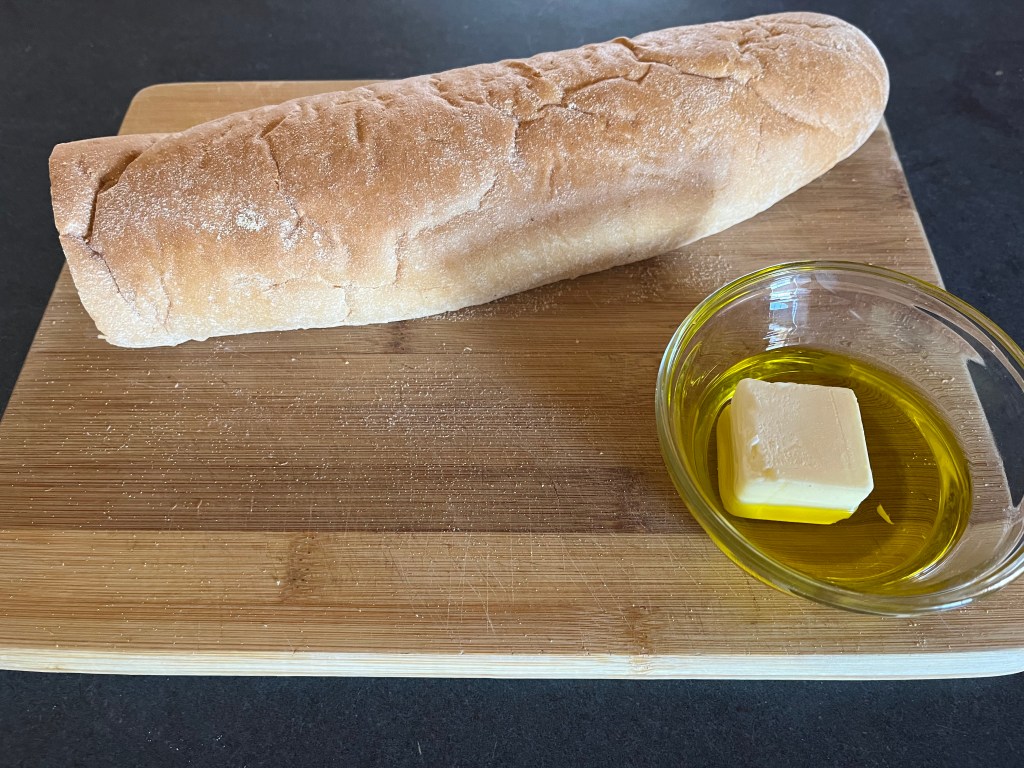
French bread (6 inch loaf)
1 green onion, chopped fine
2 tsp dried sage
2 tsp dried thyme
1 egg, lightly beaten
4 thick cut, bone-in, pork chops
Directions:
Cut French bread into ¾” slices
Melt one tablespoon olive oil and 1 tablespoon butter.
Brush bread slices with the melted butter and olive oil.
Toast the bread on a parchment paper lined backing tray in the oven, at 300° F. Remove when bread has toasted and begins to turn golden brown.
Allow the toast to air dry for a few minutes.
Crush the toasted bread, to make breadcrumbs. Combine breadcrumbs with green onion, sage, thyme and egg. Set stuffing mixture aside.
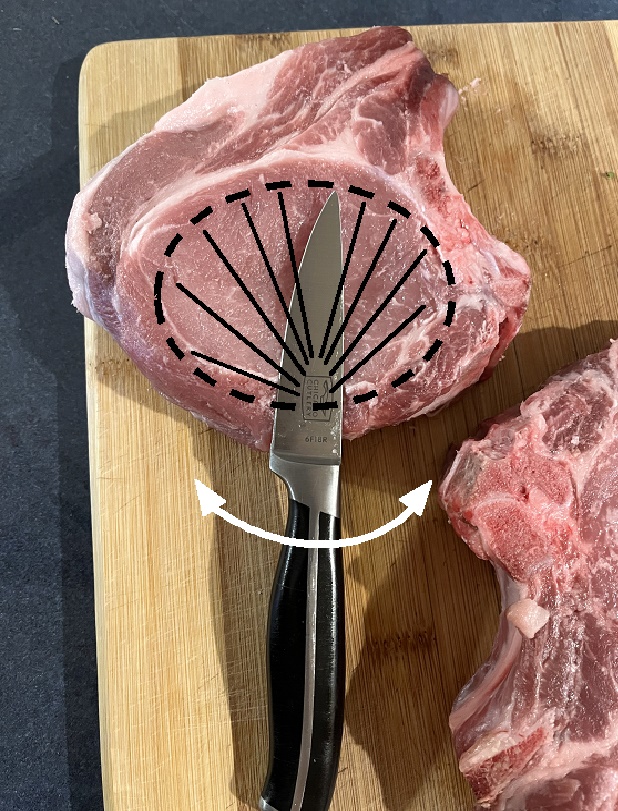
Insert a small, sharp knife into the center of the edge of a pork chop (opposite side of the bone.)
Cut a semicircle through the meaty part of the pork chop, while working the knife back and forth, using the insertion point as the center of the radial cut (see visual aid, below.) Turn the knife blade to face the opposite direction and make another radial cut, to complete the cavity.
Remove the knife and pack stuffing into the cavity. Try to fill the entire cavity with stuffing. Repeat the process with the remaining pork chops.
Sprinkle salt and cracked, black pepper on both sides of the pork chops.
Preheat oven to 350º F.
On the stove top, bring a large oven-proof skillet to medium/high heat. Add a few tablespoons of olive oil to the pan. Once the oil is hot, lay the pork chops in the skillet and sear for three minutes. Turn the chops over and sear for another two minutes.
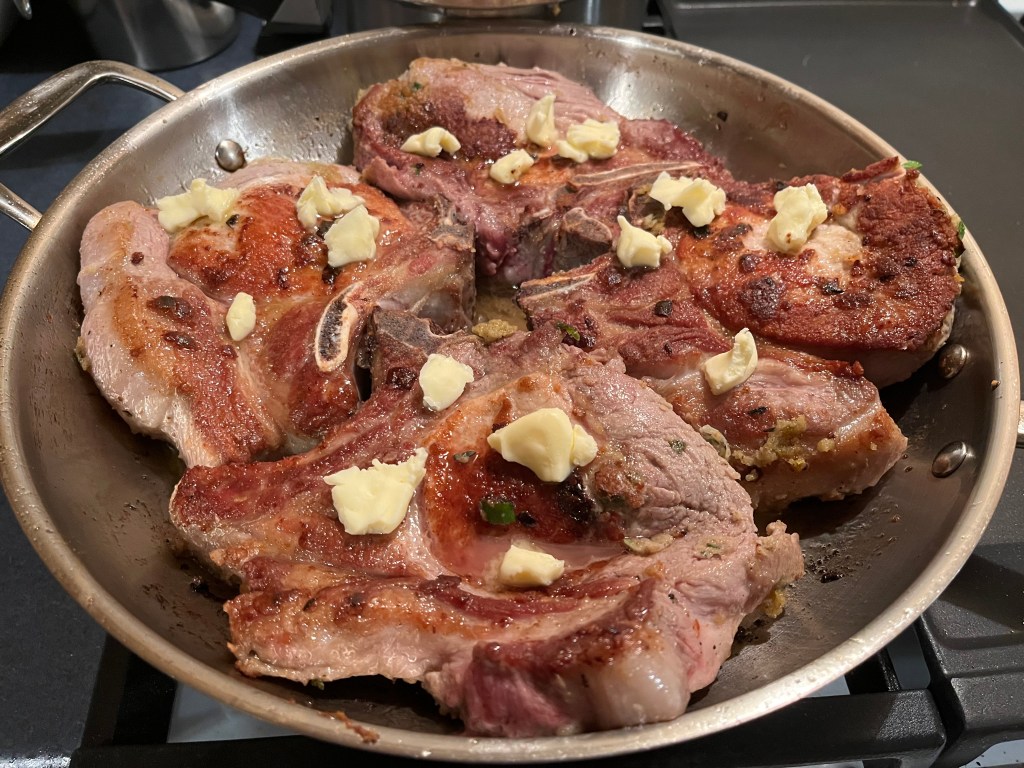
Add dollops of butter to the tops of the pork chops, (about two tablespoons of butter.)
Cover the skillet with aluminum foil.
Bake the covered pork chops for 30 to 35 minutes in the oven. Check the internal temperature of the pork chops. It should reach 145º F. Remove the skillet from the oven and remove the aluminum foil. Allow the pork chops to rest for 5 to 10 minutes.
Serve the pork chops with anything you like. Mashed potatoes, glazed carrots, cooked greens, apple sauce or, macaroni and cheese would all make great side dishes.
Here’s something for the couple that wants to celebrate Valentine’s Day but doesn’t want to go out to eat, after a long Valentine’s Day, at work.
Ingredients:
5 or 6 large raw shrimp, peeled and deveined
4 or 5 cloves of garlic, mashed
1 tsp red chili flakes
3 Tbs olive oil
2 Tbs clarified butter (I used a garlic dipping sauce from a recent pizza delivery)
1 uncooked, spicy Italian sausage
1 Tbs butter
1/4 cup heavy cream
1/4 cup dried Parmesan cheese (straight from the can!)
2 ounces sliced Mozzarella cheese
a few black olives, pitted and sliced
3 green onions, chopped
prepared pizza dough (follow the recipe of your choice)
Directions:
Prepare the pizza dough and let it rise. While the dough rises, prepare the other ingredients.
Slice the shrimp in half, lengthwise. Marinate the shrimp in olive oil, garlic and red chili flakes.
Pan fry the Italian sausage and chop into small pieces. Set aside.
chop the green onion and set aside.
In a medium sized skillet, add the clarified butter and butter. Simmer at low heat to melt the butter. Add the heavy cream and mix, briefly. Turn the heat up to medium to thicken the cream sauce. Add the Parmesan cheese and gently whisk to combine. Remove from the heat when the sauce is thick and creamy.
After the dough has risen, roll out the dough out on a floured surface. Spread the dough into a circle. With a pastry cutter, slice a triangular wedge from the rim of the pizza dough. Curl the edges of the dough with your fingers and form the tip of the heart, on the opposite side of the triangular cut. Curl the edges of the dough in the cut area to form the top of the heart.
I prebake pizza dough in the oven at 400° F for about 10 minutes and then remove to add toppings.
Pour some of the olive oil marinade onto the prebaked dough and spread it across the dough. Add the raw shrimp and mashed garlic. Add the Mozzarella cheese slices and chopped, cooked sausage. Top with sliced black olives and green onions.
On any given day, I can search my refrigerator and find fruits and vegetables that, only a few days before, were vibrant and beautiful. What sad fate is in store for those items, that I have passed over and ignored? Often times, they sit, tucked away in the deepest corners of the produce compartment of my refrigerator until, one day, I acknowledge the awful truth. All good things must come to an end.
But, before I throw in the towel, I like to find a way to use the fruits and vegetables that have “gone south.” I am reminded of an excerpt from Jacques Pépin’s book, “Heart & Soul in the Kitchen” entitled, ‘For the love of wilted vegetables’. Jacque is a kindred soul who, like me, hates to see anything go to waste.
Today’s example is a lime, a lemon, a jalapeño, and a wedge of onion, that have past their prime, but not past their worthiness.
I was going to make salmon today and I was pawing through the refrigerator, looking for a lemon, when I came across these sad little items. They inspired me. In fact, I tossed the idea of salmon to consider what sort of noble thing I could do with the slightly wrinkled and discolored fruit and onion.
A marinade! Yes, indeed!
The pieces came together in my head quickly. I will marinate some chicken and make chicken fajitas for dinner.
Marinade ingredients:
Juice of 1 lime
Juice of 1/2 lemon
1 jalapeño, chopped
1/4 large white onion, chopped
1 tsp garlic powder
1 tsp black pepper
1 tsp salt
1/2 tsp oregano
1 1/2 tsp ground dried onion
1 1/2 tsp cumin powder
1 1/2 tsp Tajin seasoning
1 tsp smoked paprika
2 tsp chili powder
Three hours later, after allowing the chicken to thoroughly marinate, dinner was served.
What can you do with your vegetables and fruit after they have gone south?
Is it just me, or does the idea of combining shrimp and eggs just seem weird? Oh, I’m sure that there are bound to be chefs out there that know recipes that call for shrimp and eggs but, I’m just a simple home cook and, until this morning, shrimp and eggs lived in two different worlds.
Eggs are extremely versatile, and there are many ways to prepare shrimp but, combing them into one dish never crossed my mind. That all changed when I found some raw shrimp in the refrigerator this morning. My daughter made (excellent) shrimp quesadillas a few nights ago and there were a few shrimp left over.
Raw shrimp doesn’t last long in the refrigerator so, quick action was needed. I had planned on making simple scrambled eggs in the wok for breakfast but, I felt a sudden compulsion to marry the shrimp and eggs. It was a beautiful ceremony!
Ingredients:
8 large, raw shrimp, peeled and deveined
4 large eggs
1/4 cup chicken broth
Salt and black pepper, to taste
1/2 teaspoon sake
1 teaspoon oyster sauce
1 green onion, thinly sliced on the diagonal
2 Tbs canola oil
Directions:
In a bowl, lightly beat the eggs. Add chicken broth, salt, pepper, sake and oyster sauce. Stir quickly, to incorporate. Add green onions.
Heat a wok to medium-high heat.
Add 1 tablespoon of oil to the wok. When the oil is hot, add the shrimp.
Briefly stir-fry the shrimp until they turn pink. This might take only one minute. Remove the shrimp and set aside in a warm place.
Add a tablespoon of oil into the wok and turn the heat on high. When the oil is hot, add the egg mixture.
Scramble gently for about 1 minute, then return the shrimp to the wok.
Continue scrambling until the eggs are almost cooked. Remove from the heat and let it rest for a minute before serving.